Taking your Pulse – North African Spiced Grain Salad

Lentils and Grains

In case you didn’t know whole grains, legumes and pulse should be in your diet.  Okay, that’s besides what’s in the your favorite beer of the moment.  And let’s be real here.  Like most I do like some of my grain intake in a fermented, liquid form but it does not have to be all crunchy, granola-y or boiled brown rice.

The world of grains has many faces, Farro, wheat, rice, barley, millet, rye and corn for a short list.  Legumes include beans of all ilk, black, white, red, Hutterite, Jacobs cattle, scarlet runner to name a few. Pulse however is just another word for Legume or bean which derives from the Latin, puls and from ancient Greek, poltos (which means a meal of a stew thickened with beans or legumes). And there you have your word of the day and extra points in Scrabble.

From a culinary viewpoint these ingredients offer a range of flavor advantages.  Grains like Farro have a nutty complex flavor with hints of oat and barley.  Barley, meanwhile is mellow, grassy flavored with an almost creamy mouthfeel and subtle floral undertones.

Pulses or Legumes are 20 to 25% protein by weight, which is double the protein content of wheat and three times that of rice.  Pulses(or beans/ legumes) are generally pretty high in protein, and the digestibility of that protein is right up there too.  Interestingly, they are often relatively poor in the essential amino acid methionine. Grains (which are themselves deficient in lysine)  which is why slotting them into your weekly menu together helps to form a complete diet of protein.

And so this little culinary journey leads us to today’s recipe which is inspired by Mourad Lahlou’s recent New Moroccan cookbook.  While you scramble for the pantry keep in mind three key points for this recipe.

  1. Its hella nutritious.
  2. Its vegan.
  3. And its delicious.

North African Spiced Grain Salad     (serves 6)

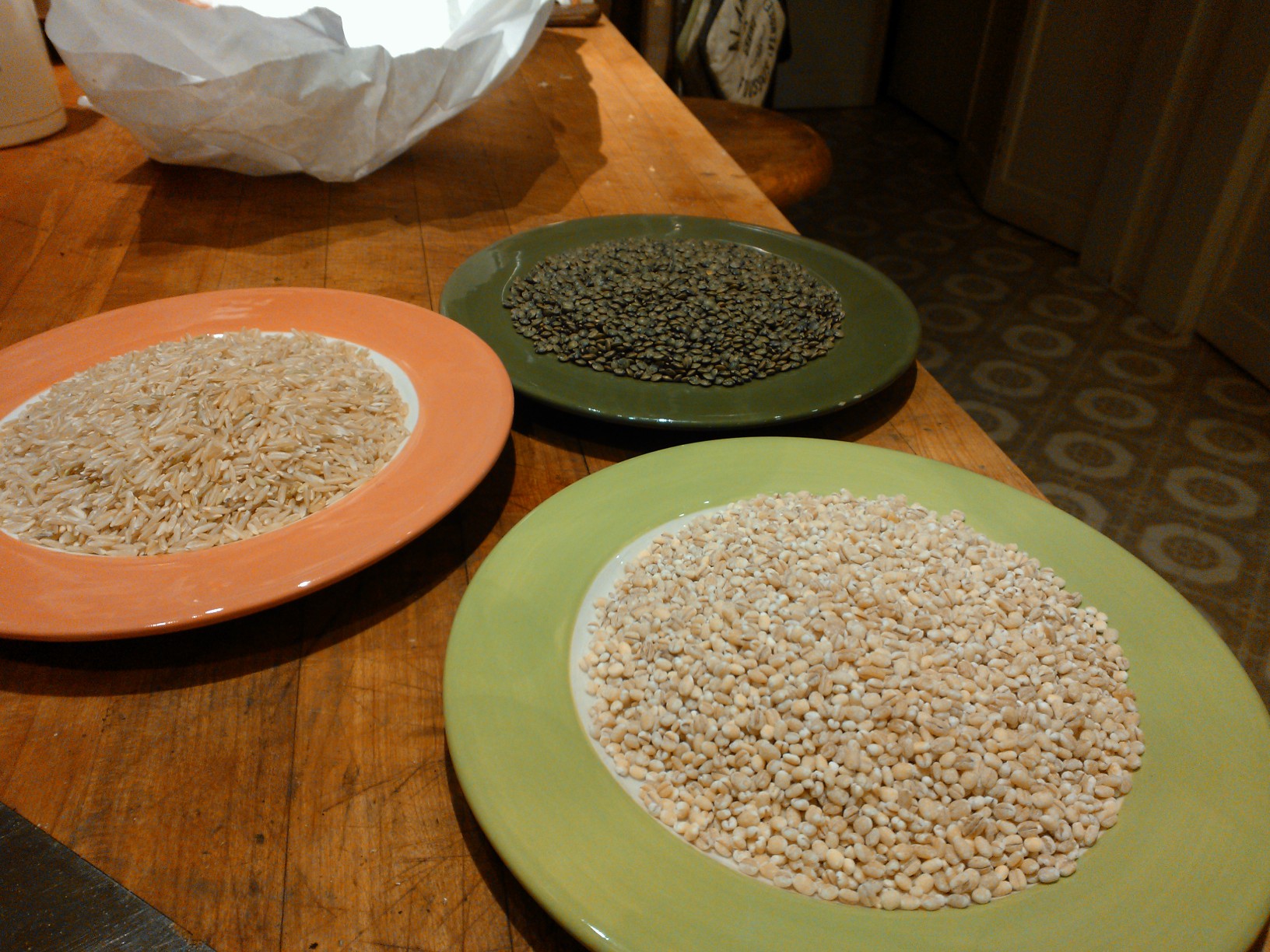
  • 1 cup Brown Rice ( I like to use the brown basmati rice that can be found in stores like Rainbow Grocery here in SF or at other stores like Whole Foods)
  • 1 cup Barley
  • 1 cup Green French Lentils  (these are the dark green ones that hold their shape nicely when cooked – not their light-colored cousin that we use for Split Pea soup a personal favorite of mine)
  • 2 cloves garlic, minced or chopped fine (remember the microplane)
  • 1 teaspoon kosher salt
  • 3 teaspoons Ras el_hanout   a heady mixture of spices from north African regions.  There are many variations and you can just as well do one yourself.  There are many decent versions on the web.  Here is on. Assemble spices then grind together as finely as possible in a spice grinder (actually we use coffee grinders for this in kitchens and simply sift out any large pieces.)  (In  a pinch you can substitute 1/2 teaspoon cumin seed, 1 teaspoon coriander seed, 1/8th teaspoon whole black pepper, 1/8th teaspoon whole fennel seed- lightly toast these in a saute pan for a minute or two until they become fragrant then grind together and mix with a pinch of nutmeg, cinnamon and 2 teaspoons mild chile powder.)
  • 1 bunch parsley, chopped
  • zest  and juice of 2 lemons
  • 2Tablespoons extra virgin olive oil (use the best you can afford-always!!)
  • 1/4 cup onion diced small.
  • 1/2 cup black olives (optional) pitted and chopped large pieces
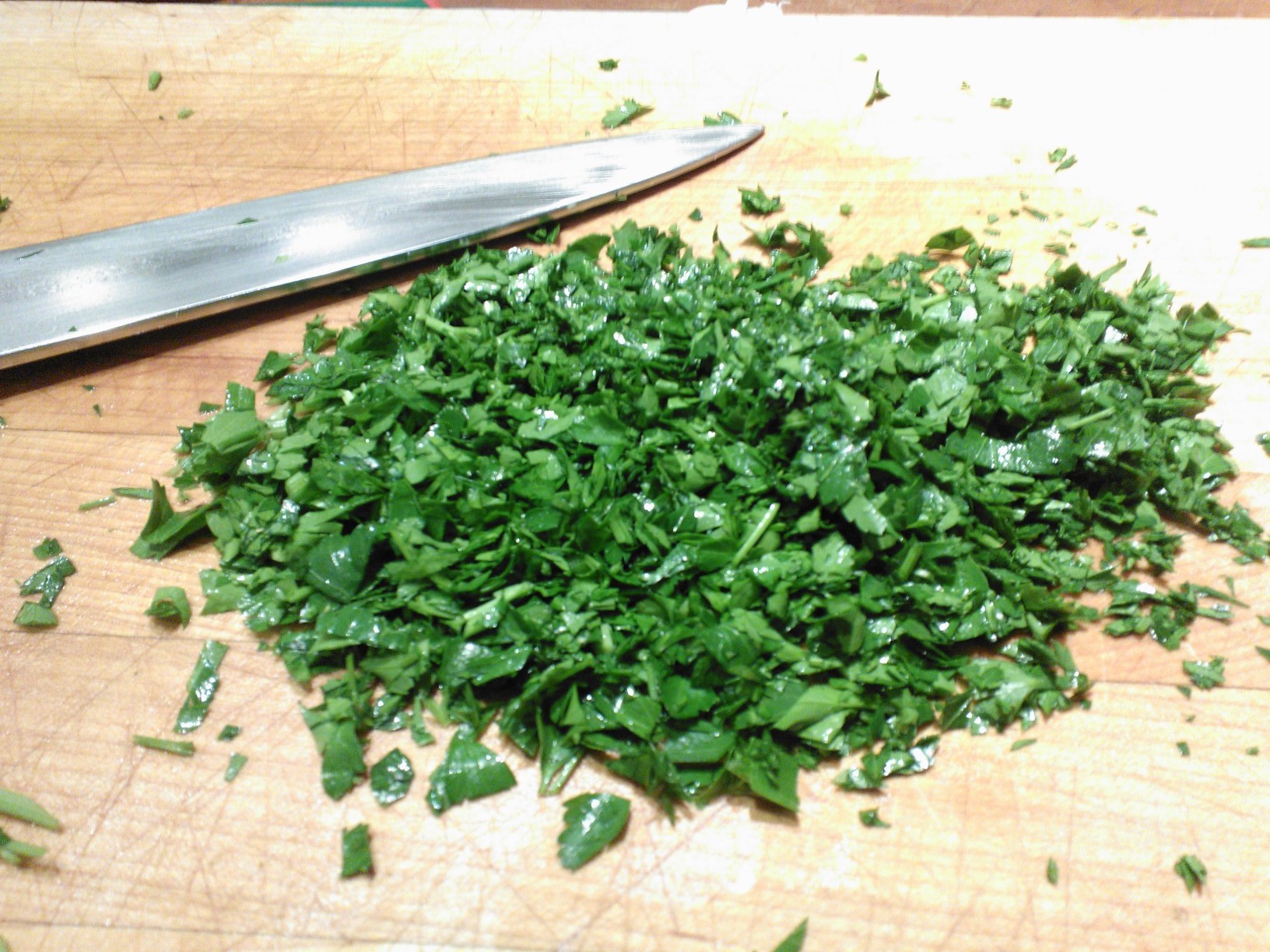
  • 1/2 cup pistachios (or almonds) lightly toasted and coarsely choppedChopped Parsley

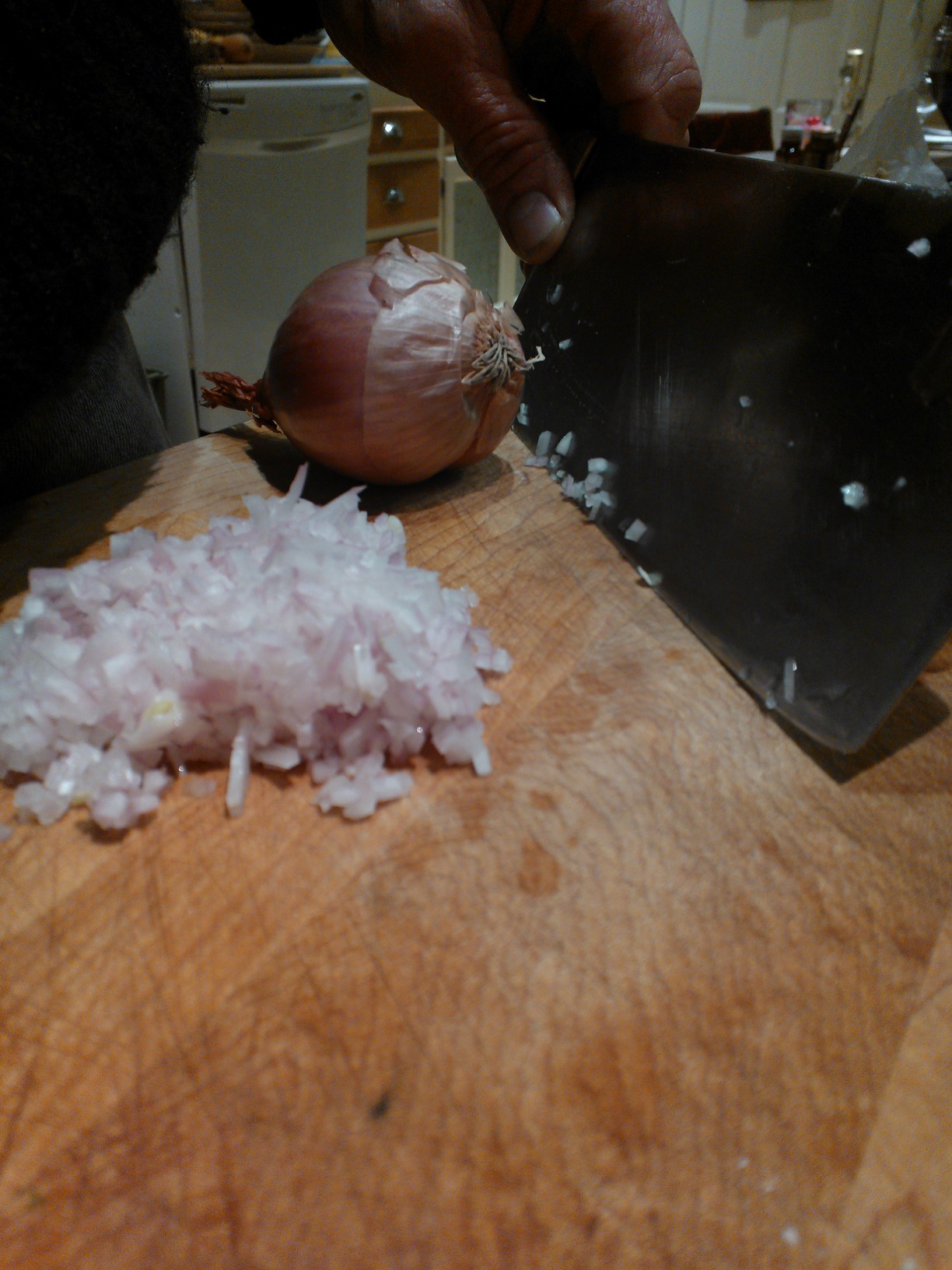
Onion, garlic, olive, nuts

The hardest part of this is that you have to cook the lentils, rice and barley separately.  Place each in a small separate pot.  Add 21/2 cups water and bring to simmer. Cook each until done.  This will take approx 20- 22 minutes for the lentils and approx. 15-18 minutes for the barley and rice.  Take care not to over cook so taste them several times towards the end of the cooking time.  Time will vary a bit.  When done drain each of all water and let let in a colander for a few minutes then combine in a large bowl.
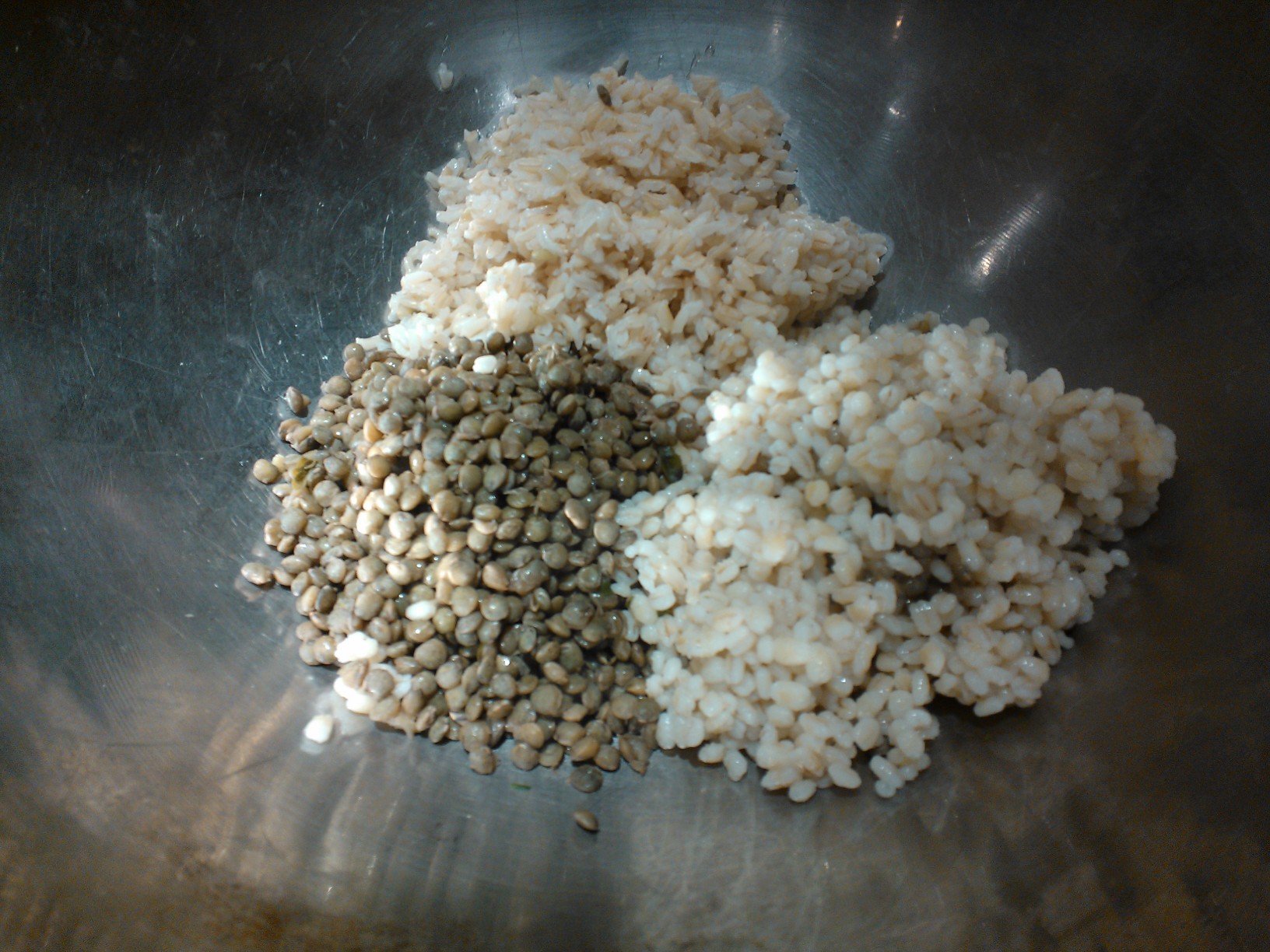
Cooked Grains

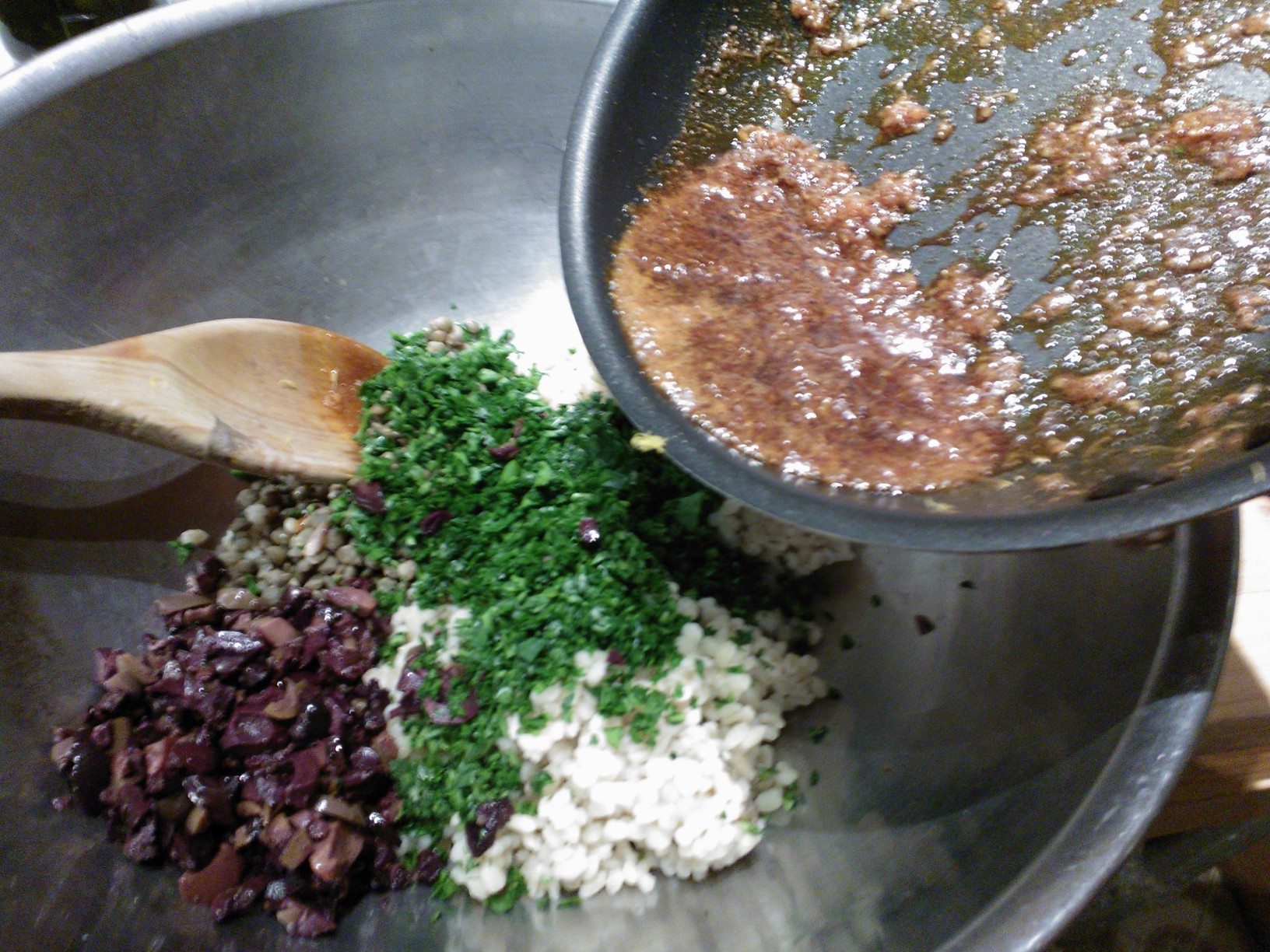
In a small sauce pan heat the olive oil.  Add the onion and garlic and cook slowly for 3 minutes stirring occasionally.  Next add the Ras el_hanout and stir well.  Let this cook slowly for a minute then pull off the heat and pour over the grain, rice, lentil mix.  Stir in then add the lemon zest, juice, salt and chopped parsley.  Lastly add the olives and chopped almonds.

Spices in Oil

Ras el Hanout mixed in the olive oil

Seasoning the mix

Addding spiced oil mix to cooked lentils and grains.

Serve this as a warm or room temperature salad with a range of dishes be they vegan, vegetarian or not.  At my house I will serve this with a winter squash tagine, grilled or roasted fish, pork or poultry.  Serve with a light, fruity red wine like a Sicilian Frappato. Or perhaps a locally brewed Saison style beer.

Finished Salad

Nutrition Facts Serving Size  (289g)

Amount Per Serving Calories 460    Calories from Fat 130    % Daily Value Total Fat 14 g 22 %  Saturated Fat 1.5 g 8 %  Trans Fat 0 g    Cholesterol 0 mg 0 %  Sodium 420 mg 18 %  Total Carbohydrate 71 g 24 %  Dietary Fiber 12 g 48 %  Sugars 2 g    Protein 14 g

Vitamin A   20 %  Vitamin C   25 %  Calcium   6 %  Iron   20 %

Building Flavors part 2- Roasted Black Cod with Porcini Mushroom Sauce

Pan Roasted Black Cod, porcini mushroom sauce, pickled shallot, thyme

Last month in the post Building Flavors  we worked through a dish of Ahi Tuna, Udon and braised greens with a spicy soy and ginger sauce.  Since we had such interest in the dish and the idea of adding flavors to a dish and ingredients we’re going into round 2 of Building Flavors.

This time we’re going to stay with the seafood theme for the main ingredient and fiddle around with the sauce that goes with it.

For the fish part of this dish its going to be Black Cod aka Sablefish. Here is we go off a bit about what we eat and why. Black Cod is  a terrific, unctuously flavored and textured fish that works equally well for roasting in the oven or on top of the stove in a saute pan.  It also will give excellent results when steamed or poached.  Because the fish live deep in the cold waters off the north Pacific Coast its flesh possesses a good amount of natural oil which translates to a beautiful  moistness when cooked.  (Note: this moistness means its easier to cook without worrying about drying out it it sits in the heat a little too long.)   Another big plus is its rated Best Choice  by the Monterey Bay Aquarium Seafood Watch Guide.  Essentially this means that the species’ population is in good shape and abundant due to the good and efficient fish stock management by both the fishermen and government agencies.  As today’s fish market have more than  their share of pitfalls and questionable choices having a seafood that rates this good is…..a really good thing, especially for the fishermen.  Eat this fish with a clear conscious.

Now let’s get cooking.  This dish will take you about 15 minutes to pull together.

WP_000504

Serves 2

  • 12 oz Black Cod filet (divided into two 6 oz pieces, bones removed)
  • 4 oz medium regular mushrooms sliced thin (white or brown is fine)
  • 1 clove garlic, minced or chopped fine( a microplane works super for this)
  • 1/2 oz dried Porcini Mushrooms soaked in 2 Tablespoons warm water (shoot, if you happen to have fresh then hey, use them for sure)
  • 2 sprigs fresh thyme
  • 2 1/2  Tablespoons extra virgin olive oil
  • 1/4 cup white wine
  • 1 cup chicken or vegetable broth
  • 1 teaspoon fennel seeds
  • 1/4 teaspoon kosher salt
  • 1/8 teaspoon black pepper fresh ground
  • 1 shallot, peeled and diced small
  • 2 Tablespoons white wine vinegar

WP_000506Timing for this dish goes as follows.

  1. Season Fish
  2. Prepare and Cook mushroom sauce
  3. Pickle shallots
  4. Cook Fish
  5. Reduce/ finish sauce and plate

First pre-heat the oven to 400F.

If the filets are a bit large trim them to 6 oz pieces.  You will find a line of bones down the middle of the front third of the filet.  Trim these out by cutting a V shaped cut around them.(you can also have your fish counter person do this for you).  Season the fish with the crushed Fennel Seed. kosher salt and fresh ground black pepper. Set this aside while the oven heats up and we get the sauce going

In a small bowl mix the diced shallots with the white wine vinegar, a small pinch of salt, a small bit of black pepper and 1 tablespoon of the olive oil.  Let this sit and marinate as the rest of the dish takes shape.

.WP_000505

Next its sauce time. In a large bowl combine the sliced mushrooms, minced garlic, thyme, 1 1/2 Tablespoon extra virgin olive oil, a pinch of salt and black pepper

Heat a sauce pan or non stick saute pan heated over medium high heat to get it nice and hot.  Add the musrhooms to the pan and cook over a medium high heat for about 3 minutes stirring occasionally.  We want to get some color on them that will help develope a richer flavor.  Think Umami.

WP_000513

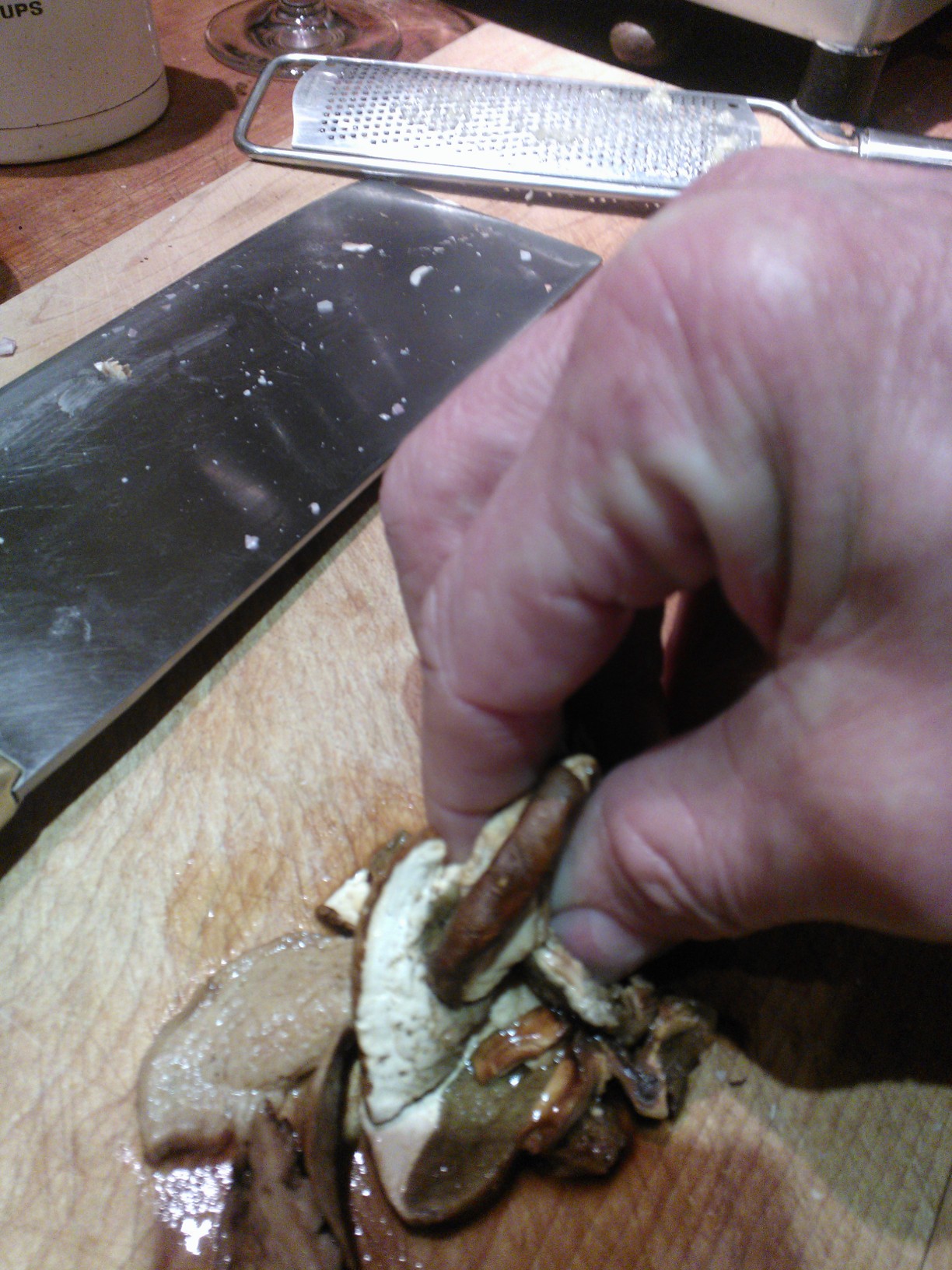
While the mushrooms are cooking pull the soaking dried porcini mushrooms out of the liquid and chop up into small pieces.

WP_000510

Add the chopped porcini to the pan with the rest of the musrhooms and give a stir.  If it looks like its going too fast for you just turn the heat down low.

Next add the white wine.  Let the wine cook down till it pretty much disappears.  Next add the  soaking liquid from the dried mushrooms and the stock.  (Note:  If you are so inclined this is where you could add a 1/4 cup or so of a rich meat stock or demi.  One trick we do in restaurants is to make a small stock of mushrooms, onion, carrot and celery with thyme.  This can be reduced down and strained and saved for occasions like this)

WP_000514

Soon you’re going to enjoy the heady aroma of wild, forest mushrooms filling the kitchen.  Reduce the heat on the pan and let it simmer slowly while you finish the fish.  There, sauce is almost good to go.

Now we cook the fish and get ready to have dinner.  Heat a 8 -10 inch non-stick pan.  Add 1/2 tablespoon of the olive oil and swirl the pan to coat.  Slide the Cod filets into the pan and keep the heat at medium high.  Place the pan with the fish in the oven.  Roast the fish in the oven for about 3-5 minutes depending on the size of the filets.

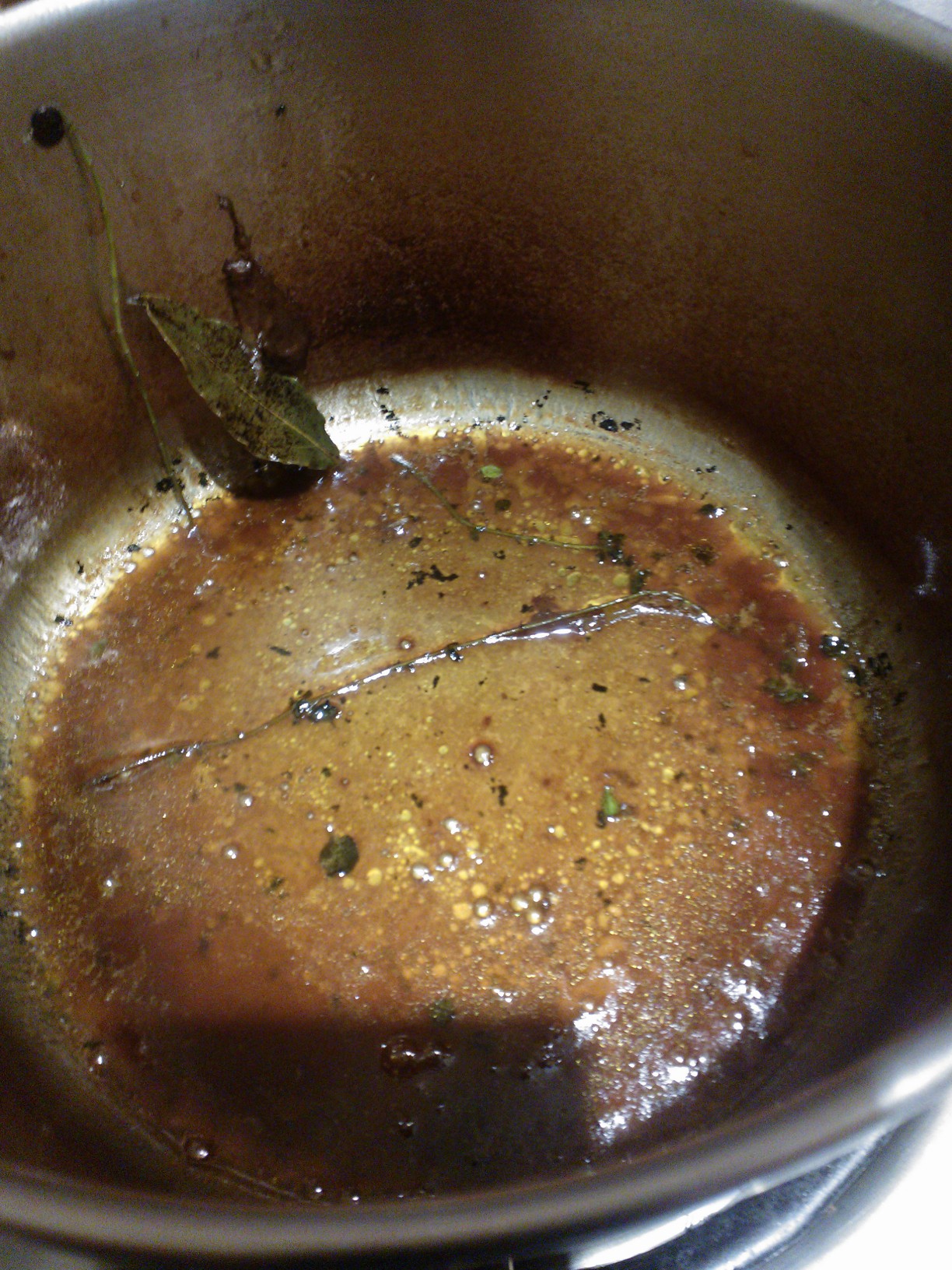
When the fish is done pull the pan out and let it rest for 3 minutes while you finish the sauce and pull togther any side dishes. Using a wide flat, spatula transfer the cooked fish to your dish.  Spoon out the mushrooms over the roasted cod.  One of the tricks here is not to just dump the sauce on the fish but to actually “spoon the musrhooms” on top of the fish leaving the mushroom liquid in the pan.  If its a bit too thin you can give it a quick and furious blast of heat to reduce it down to a glaze like texture.  Then spoon the reduced liquid AROUND the fish in a drizzle.  Its gonna look way cool.

WP_000516WP_000517

Next spoon a teaspoon or so of the pickled shallot mix around the fish in several places on the plate.  The idea here is that the sharp bite of the pickled shallot will cut through the richness of the cod and mushrooms.  I like to add a few torn leaves of radicchio or cress to the plate as a counter point on the palate.

Serve with some roasted potatoes or a grain like farro.

WP_000518

SWEET POTATO VEGGIE BURGERS!

YUM!!!

Today I’m featuring a really tasty burger.  Anne Guzman from the Peaks Coaching Group graciously granted permission to re-post it here.

All burgers aren’t created equal.  Apart from the greasy, fat laden to the lean and not very interesting a host of styles abound.  There are the meat centric kind like the grass pastured beef version at  kronnerburger here in the Mission in SF.  Also you’ll discover supurb versions made using ingredients like tuna, mushrooms, tofu, blackbeans or other whole grains. Here is a great idea putting sweet potatoes to good use.  Sweet potatoes and yams fall into the super food category.  They deliver heaps of vitamins A and C as well a the requisite carbohydrates a starchy tuber contains.  Along with these they supply big bang for the ounce of the athlete’s essential minerals; potassium, magnesium and calcium.  They shold be in your diet.   If not here is a great way to start.

Here’s a great alternative to a heavy meat burger! Give it a try this weekend! It’s pretty simple! Spice it up however you like!

Ingredients:

  • 2 cans cannellini white beans, drained (Each can is 1 3/4 cups drained beans with Progresso beans) (Cannellini beans are large and have that traditional kidney shape. With a slightly nutty taste and mild earthiness, they have a relatively thin skin and tender, creamy flesh).
  • 1 large sweet potato, baked/peeled/mashed (about 2 cups)
  • 2 Tbsp tahini (sesame seed butter)
  • 2 tsp pure maple syrup
  • 1 tsp lemon pepper seasoning OR Cajun seasoning (or another fave spice!)
  • 1/4 cup wheat flour or brown rice flour or gluten free flour (there are some good pre-made gluten free flours on the market now)
  • Optional: additional seasoning (whatever you have on hand – I used a few dashes cayenne, black pepper or chilli pepper)Salt to taste if needed
  • Panko crumbs (you will dip each Pattie in the bread crumbs, about 1 cup total)
  • Olive oil for pan- lightly oil just to avoid sticking
  • 2 whole wheat buns or gluten free buns
  • 2 avocados for toppings
  • TOPPINGS TO CONSIDER!!! Dijon mustard, pickles, onions as desired OR you can use a mango chutney and roasted red peppers as toppings.

Directions:

1. Bake sweet potato. Peel, place in large mixing bowl. 2. Add drained beans to mixing bowl. Mash beans and potato together. (you can use a food processor or a fork) 3. Mash in seasoning, flour and any additional seasoning. Your mixture will be quite soft and moist,but you should be able to form a patty. Add more flour or a scoop of breadcrumbs – or dry rice to thicken the mixture if needed. 4. Heat 1 Tbsp oil in a pan over high heat. 5. Form a patty from mixture and coat in Panko or gluten free bread crumbs. Thick coating. Then drop the patty in the pan. Repeat until the pan is filled. Cook until browned on both sides. You could also bake. If baking, use less Panko. 6. Transfer cooked patties to paper towel. Cool for a few minutes. 7. Serve on toasted bun with lot of yummy toppings!

Editor’s Note:  This mix will make enough for about 4 burgers.

Nutrition Facts Serving Size  (392g)

Amount Per Serving Calories 590    Calories from Fat 220    % Daily Value Total Fat 25 g 38 %  Saturated Fat 3 g 15 %  Trans Fat 0 g    Cholesterol 0 mg 0 %  Sodium 770 mg 32 %  Total Carbohydrate 78 g 26 %  Dietary Fiber 16 g 64 %  Sugars 16 g    Protein 20 g

Vitamin A   390 %  Vitamin C   40 %  Calcium   20 %  Iron   30 %

originally posted on December 14, 2012

Pasta- keeping it simple

WP_000535Pasta.  For many of us athletes its become the common denominator for the fuel that keeps us going.  It comes in many shapes, sizes, flours and ethnic origins.  According to some research there might be over 600 types out there.  From spaghetti and penne to soba and udon to egg mein and silver needle, on and on it goes.  One of the wonders of noodles are that they begin with most often nothing more than dried flour ( wheat, rye, buckwheat, rice) with water added (sometimes egg or a vegetable puree), kneaded and worked to develop gluten ( the strands of stuff that give it and bread its shape) then sometimes dried (although often used fresh without drying).  Pasta has come to be a marvelous method to provide sustenance and energy for the world’s masses for hundreds of years.

Not surprising that along the way noodles have been co-opted and absorbed by dozens of cultures around the globe yielding innumerable variations as ingredients and sauces are added.  This my friends is one of the joys and wonders of cusine and culture.

One of the glories of pasta (and noodles) is that it is really a simple food.  Each type, style and manufacturer claim a special nuance of flavor and texture.  There is no arguing that egg noodles taste and feel differently in the mouth than a thin rice noodle or rustic spelt pasta.  Handled indifferently and it produces a sad and forelorn dish.  Too often the pasta bowl ends up a kitchen sink approach to cooking with “god knows” how many unrelated ingredients piled together and sauced heavily.  While it may give you the same approximate nutritional benefit I’ll say that its poor dining at best.  Just don’t do it.  Better to heed the mantra that less is more.  A few intelligently chosen ingredients, carefully prepared are all that is needed.  That hunk of broccoli, handful of tomatoes or bunch of spinach lying about might be better on the side, cooked seperately in its own right.   Paired with a crisp salad and pleasingly robust glass of wine is the way to go.

This recipe is for a simple pasta dish using fusilli shaped pasta that is readily available (but honeslty you can certainly substitute whatever you have at hand).  The key is to be flexible, look for and develop the flavors.  Let it have some character and integrity.

For 2 servings:

  • 6 oz dried pasta (fusili or other shapes are good)(remember it will more than double in weight after it is cooked)
  • 3 oz fresh sausage (a good Italian style fennel sausage is a super place to start. But don’t be shy here.  A little more or a different flavor will be just fine.  One word of caution is for this recipe is to stay away from the sausages that contain fruit)
  • 4 oz shredded cooked chicken ( optional but a great way to build flavor, texture and add a boost of lean protein)
  • 1 Tablespoon extra virgin olive oil
  • 3 Tablespoons grated parmesan

Bring a large pot of water to boil with a pinch of salt. When the water is really boiling vigorously add the pasta.  Set the timer for 10 minutes and go to work on the rest of the dish.

Heat a large shallow saue pan (if you have a non-stick version all the better).

WP_000531

Add the olive oil and swirl the pan.  Add the sausage and let it cook for 2 minutes moving it around a bit several times.  Its okay to let it brown a bit.

Add the chicken and stir it in.  Let this cook over a medium to low-ish heat while the pasta cooks.  When its hot remove from heat and keep warm.

For the Broccoli:

  • 1 head broccoli ( or cauliflower prepped same way) trimmed into 2-3 inch pieces.  Tip: keep any leaves and cook them with the tops.  Also I like to trim off the bottom 2 inches or so off the bottom of the stalk then thinly slice it and include in the dish.  Waste not/ want not!
  • 1/2 cup water (warm)
  • 1 teaspoon dried chile flakes
  • 1 clove garlic, peeled and minced (or grated or thinly sliced) (Note: don’t sweat over this. The idea is again to build flavor.
  • 1 Tablespoons extra virgin olive oil
  • 1/8 teaspoon kosher salt
  • Optional – 1-2 anchovy filets minced small  (if you choose this route and its one I highly recommend be sure to purchase a good quality anchovy like Recca or Scalia.)

In sturdy pot with a lid heat the oil over a low heat until just hot.  Add the garlic and chili flakes and cook SLOWLY for about a minute.  Stir often and don’t let them brown.  (If you use the optional anchovy add it here)

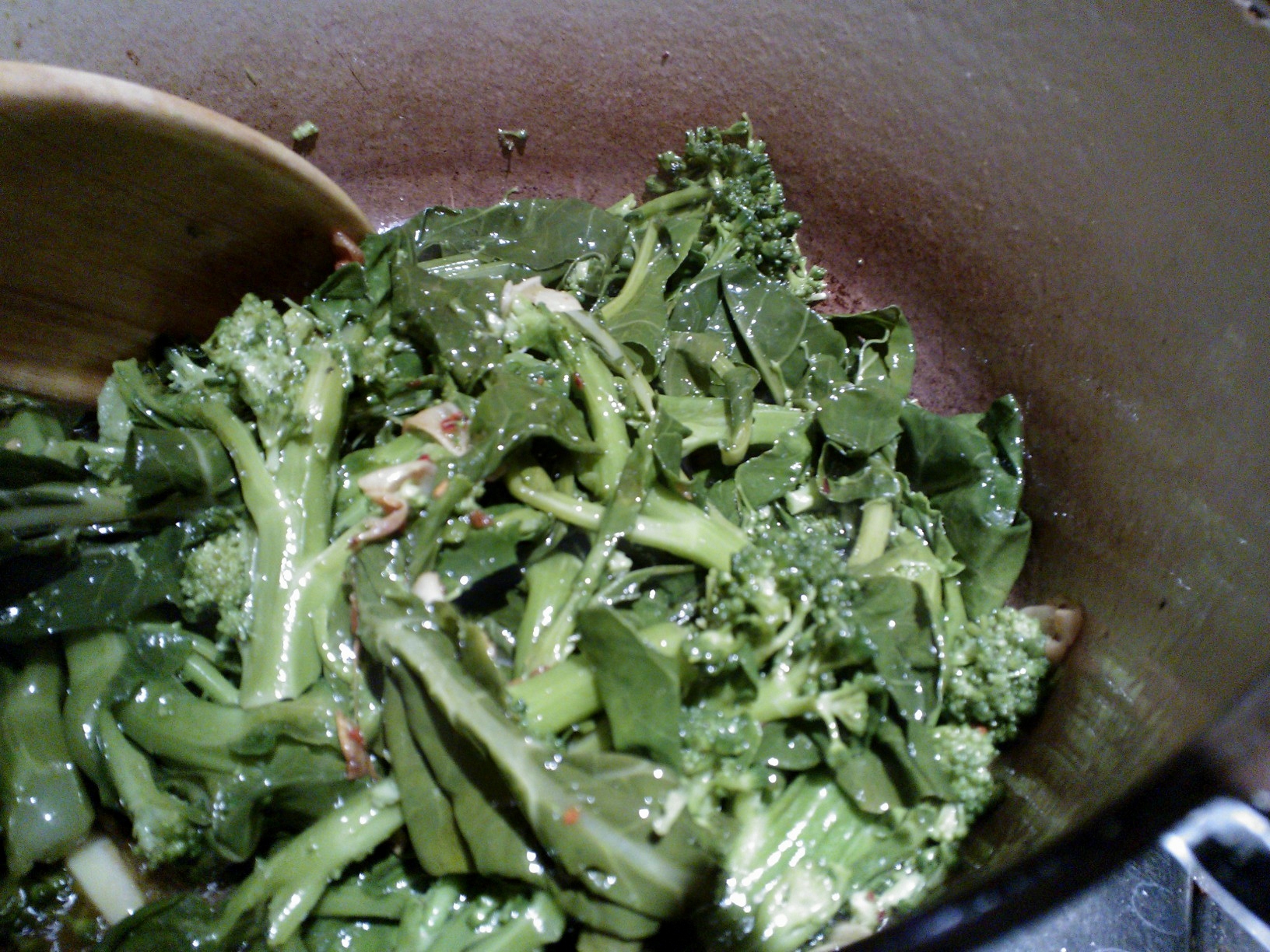
WP_000528Add the broccoli and water.  Cover the pot with the lid and raise the heat a little until the water begins to boil.  Keep the heat at a medium low level.  Stir a couple of times  and let cook for 8 minutes.

WP_000526Check to make sure the water does not boil dry.  Add the salt.  At the end of 8 minutes remove the lid.  The broccoli should be soft and just beginning to lose its bright green color.  Its okay.  If its not  cover and let cook for another 2 mintues.  Were not making crunchy steamed vegetables here.  If there is still a bit of water you can pour some off or just raise the heat and let it boil for a few minutes.

WP_000530The flavor of slow cooked broccoli is beautifully rich with a bit of umami showing thru.  Curioiusly the flavor works really well with other big flavored dishes and won’t kill the flavor of red wine.

Oh yeah, don’t foreget the salad.  Time of year keep an eye out at the markets for those super bittery salad greens like frisee, escarole and radicchio.WP_000536

Nutrition Facts Serving Size  (337g)

Amount Per Serving Calories 680    Calories from Fat 250

% Daily Value Total Fat 28 g 43 %  Saturated Fat 7 g 35 %  Trans Fat 0 g    Cholesterol 50 mg 17 %  Sodium 1340 mg 56 %  Total Carbohydrate 71 g 24 %  Dietary Fiber 5 g 20 %  Sugars 3 g    Protein 35 g

Vitamin A   80 %  Vitamin C   200 %  Calcium   25 %  Iron   15 %

An Apple a Day – blueberry/apple crisp

WP_000570On Sunday while pulling dinner together it was decided that we needed something sweet to complete the meal.  A quick inventory of the kitchen and fridge suggested a sure fire solution.  It turns out that my wife had spirited away several cups worth of fresh blueberries some time back in early October at the tail end of berry season.  Next to the bag of blueberries lay a stash of crisp topping.  Now it was beginning to take shape.  Though the berries weren’t quite enough to make a full on crisp dessert we did have a supply of super apples we had purchased the previous day at the farmers’ market.  The solution was complete.  Apple-Blueberry Crisp.

Now I have to say that all things considered the crisp is probably one of the quickest and easiest desserts out there.  Especially if you have some topping already prepped out.  Chopped up fruit, a squeeze of lemon juice, dash of vanilla or brandy, tablespoon of flour to help thicken the juices, then a generous addition of crisp topping.

The topping part is the highlight of dish most times.  The fruit, though appreciated and delicious in its way is an excuse to delight in the caramel flavored, crunchy, buttery sweet topping.  Here is a recipe for the one we had.   The instructions for the topping will yield a quantity sufficient for several recipes of fruit crisp in a 9 in x 9 in pan.  Stash the extra away in the freezer for future reference.

WP_000564

Crisp Topping (remember this makes more than you’ll need for one crisp so freeze the rest)

  • 16 Tablespoons unsalted butter, cut into small pieces
  • 1/2 cup flour ( can be All Purpose or even whole wheat, both work fine)
  • 1 1/2 cups rolled oats
  • 1 cup brown sugar, packed firmly as you measure
  • Optional -1/2 cup chopped nuts ( your call here.  Can be walnuts, pecans or even hazelnuts.  Its nice because the lend a complexity to the dish not too mention they’re hella nutritious.)
  • 1/2 teaspoon ground cinnamon
  • 1/4 teaspoon kosher salt

If you have a food processor fine.  If not that’s okay too.

In the food processor put the butter, flour, sugar, salt and cinnamon. Pulse the motor until the mixture looks like coarse cornmeal.  This should take 8-10 good pulses.  Add in the oats and give it a few more pulses.  Turn it all out into a bowl and add the nuts.  There, its ready.  Best thing to do is store it in a zip-lock bag in the freezer.  That way you can grab what you need when the inspiration strikes.

Alternatively if you do this by hand no worries, life and man existed on earth prior to the invention of the Cuisinart.  Simply put the butter, flour, brown sugar, salt and sugar in a large bowl and with your finger tips mash it all together.  Its kinda fun cause you get down and dirty with your food. Gives you a better connection to the texture of things.  You soon see the mix start to resemble that rough large graininess.  This should take 5 minutes max.  Its okay if there are some smallish lumps of butter in there, not to fret.  They’ll be okay in the end.  Add in the oats (and nuts if you choose) and mix together well, again by hand.  Voila!  Good to go!

Now the fruit.  (in a seperate bowl)

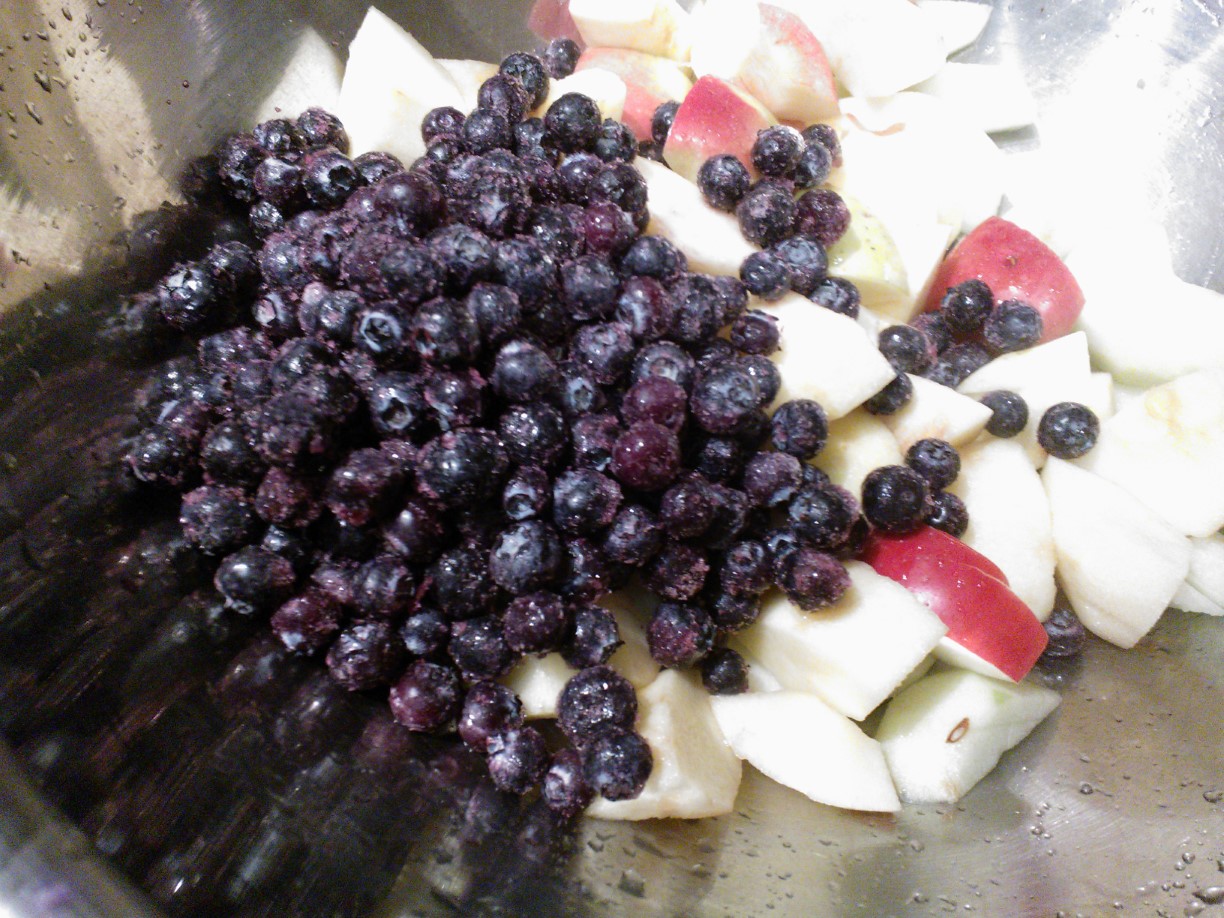
  • 6 Apples medium size quartered, core taken out and chopped into 1 inch pieces
  • 1-2 cups blueberries (fresh or frozen, not thawed)
  • 2 Tablespoons Lemon Juice + the zest of one
  • 2 Tablespoons brandy (optional)
  • 1-2 Tablespoons flour

Mix all together in bowl. Turn this fruit mix into a 9 in X 9 in baking dish of some sort.  No need to be picky but if its any larger just add a cup of fruit to compensate. Bake this in a pre-heated 375F oven for about 45- 50 minutes.  It’ll get bubbly around the edges and the top should be nicely browned.  When done remove from oven and let cool for 20 minutes.  I know this is gonna be hard but if you taste it now you’ll burn the bejeezes out of you taste buds, and that sucks.

I recommend eating this as is, or with you favorite vanilla ice cream or with yogurt in the AM.  It warms nicely in the oven or microwave too.

WP_000562WP_000565WP_000566

Nutrition Facts Serving Size  (139g) (this includes the use of almonds)

Amount Per Serving Calories 220    Calories from Fat 80    % Daily Value Total Fat 9 g 14 %  Saturated Fat 5 g 25 %  Trans Fat 0 g    Cholesterol 20 mg 7 %  Sodium 45 mg 2 %  Total Carbohydrate 34 g 11 %  Dietary Fiber 5 g 20 %  Sugars 20 g    Protein 2 g

Vitamin A   6 %  Vitamin C   10 %  Calcium   2 %  Iron   4 %

Taking apart some Food Myths

Recently the New York Times published an article by the wise and esteemed health, nutrition and science writer Jane Brody.  What You Think You Know but Don’t About Wise Eating

I’ve been reading her by lines for decades.  Even had a copy of her Jane Brody’s Nutrition Book back when I first began running seriously.  In my estimation she has always presented a well-modulated voice when it comes to feeding the human body.

Over the course of the last week Ms. Brody has been taken to task in the sustainable food press and blogs for glossing over and side stepping some of the glaring inconsistencies in her article.  While the core of the article is well intended I’d like to offer a bit of guidance on its intent.   Let’s take a look at these one by one.

Cured Meats  Here Ms. Brody suggests that steering clear of any cured meat.  It seems like a good idea.  I’m going to disagree for two reasons.  First off I’ll apply the “all things in moderation clause”.  True that cured meats like bacon (a perennial favorite of many), prosciutto, coppa, salume of all kinds carry a load of sodium and fat.  My suggestion is to use these item as a flavor highlighter.  Small amounts in salads, sandwiches, a pasta or risotto for instance can really bump up the flavor.  Remember that it may take only an ounce or less of any of these to give some big flavors on the palate.  When you start to dump the stuff in without thinking its over kill.  Its dumb and a waste of good food.

Her concern about cured meats that use the concentrated celery juice as a replacement for nitrites is a bit unfounded.  The powdered celery and celery juice contain high amounts of nitrites which along with salt, sugar and time are the foundations for good effective curing.

Michael Ruhlman in his blog sums it up pretty well on this one.  http://ruhlman.com/2011/05/the-no-nitrites-added-hoax/

“Please, if someone can tell me what is wrong with nitrites (in green vegetables) and nitrites (in curing salts and in our bodies, a powerful antimicrobial agent in our saliva, for instance), I invite them to do so here.  In the 70’s there were studies finding that at high temps, they could form nitrosamines, cancer causing compounds.  I don’t disagree, but burnt things containing nitrite are bitter and unpleasant so we’re not likely to crave them in harmful qualities.”

Meat Glue  Whoa, betcha haven’t been running into this one on your shopping trips recently.  On this one I don’t have a any disagreements.  Some restaurants might be using it.  Most often this is going to be in spendy, trendy food joints.  Think molecular gastronomy.

Trans Fats-  They’ve been taken out of nearly all foods.  By Law.  They were never any good to begin with.  Just a cheap way to make cheap food cheap.  Her statements about “naturally occurring” trans fats is accurate.  The point about conjugated linoleic acid should be well taken.  For instance one place you’ll find it is in grass pastured animal meats.

Organics As I’ve written previously in the the well seasoned athlete / the-sustainable-athlete its wiser for us to think local and seasonal first.  Organics are great but if you shop at Trader Joe’s for your organic red and yellow bell peppers, tomatoes or bags of greens look closely at the label to see where they were grown and harvested.  My research has that stuff coming from far, far away.  Her points on the health benefits of organic over conventional are ok.  As far as genetically modified foods the most important thing is labeling.   They must be labeled.  Vote for it next time.

Farmed Salmon- Sadly,  Ms. Jane Brody should be pilloried for her comments on this.  I’ll be up front and say that aqua cultured fish is the future of fish.  Tilapia, Catfish, Striped Bass, Sturgeons, Steelhead, Char, Trout and some shrimp are raised, successfully on either an all vegetarian diet or a primarily vegetarian diet.

Salmon however is not the future of fish.  Her logic that there is simply not enough of it to justify farming it so we can continue to eat it is just absurd.  The bio mass loss is still too steep, roughly 4 lbs. of fish to create one pound of farmed salmon.  (see End of the Line  and  Four Fish  )  Couple this with the environmental impact of salmon farming and it’s a non-starter.  Sea lice infestations spill over into wild fish populations.  Heavy use of antibiotics are necessary to keep the salmon healthy.  The chemical Malachite_green is used to treat the netting so the abrasions incurred by the densely packed in salmon don’t become infected.  Best to just say no to farmed salmon.  There are other, much better, alternatives out there.  And if you happen to live near a market that sells the real live wild version, buy it when you can.  You’ll be helping out a salmon fisher somewhere.

Nuts-  Again Ms. Brody is right and on the money.  Nuts and nut butters are tremendous sources of protein, antioxidants, vitamins, minerals and fiber.  Also, they taste good and can be used in a variety of forms. (whole, chopped, sliced, ground into meal, ground even finer into flour).  They shouldn’t be saved for the occasional small bit on a salad. Think almond flour (or other nut meals) as a substitute for some of the flour in waffle or pancake batters, cookies and the like.  You can make your own nut butters which can be a very tasty way to pull together a hummus (think walnut butter and white bean hummus with ancho chile and lime).

So happy eating.  My hope is that you are following the well seasoned athlete.  If you’re shopping intelligently, cooking smart and eating well then you’re on the right track.

House Made Granola – Bulking Up

WP_000497Much of the information presented here at The well seasoned athlete focuses on basic cooking skills and technique.  This installment emphasises how to pull together a very simple recipe but fine tune it with a few steps that will get you a better, tastier product.

While I don’t usually eat a big breakfast each day there is one thing that is most commonly eaten in our household.  Home made granola.

The arc of my personal relationship with granola over the years has gone something like this:  started eating the stuff out of boxes (whoa! really sweet); then making my own (not as sweet but still too sweet and usually overcooked); to buying the bulk versions (and working through the myriad of flavored versions) and finally settling on making my own again.

Granola might be one of easiest things to put together.  It requires practically no special equipment or know how.  And with something like 4-6 ingredients that can be mixed together quickly homemade granola can be pulled together for around $2.40 a pound for the most basic of versions to $3.60 a pound for the more zoot recipe we’ll go through here.  That’s quite a bit of savings when you pay as much as $4.99 / lb for the Quaker Oats version while the bulk bins show prices from $5.29 to $3.85 per pound.  The bulk versions are still too sugary for my palate.  Add to this that the purist in me blanches at the thought of pumpkin pie spiced cranberry granola.  It just ain’t right.

Here is the recipe with a couple of tricks that will help you realize a wonderful version of your personalized granola.  Remember that you can customize the recipe in several ways by adding your favorite nut, nut combination, make it a bit sweeter if that is your liking or adding ingredients like flaxseed meal or dried fruit.  The two important tricks here are 1. warming the sweeteners and oil together, adding them to the granola mix, then baking; and 2. add the unsweetened, shredded coconut at the very end of the baking process. Also if you intend to add any dried fruit add it at the end same as the coconut.

Following these steps will make for a better, more evenly toasted granola.

WP_000484

  • 4 cup oats
  • 1 cup spelt flakes
  • ½ cup sunflower seeds
  • ½ cup sliced almonds
  • ½ cup unsweetened coconut
  • 2 Tablespoons brown sugar
  • ¼ cup maple sugar
  • ¼ cup honey
  • 2 Tablespoons olive oil
  • 1/8th teaspoon kosher salt

First mix together the oats, spelt, sunflower seeds, sliced almonds in a large bowl.  Add the salt.

WP_000485

Next in a sauce pan combine the olive oil, maple syrup, honey and brown sugar.    This step will allow you to combine the liquid ingredients together in a more uniform manner and mixing them into the oats/ nut mixture will be much, much easier.  Again it will yield a more uniform seasoning of the ingredients.

WP_000486-01

Warm this mixture over a low flame.  It’ll take about 3 minutes.  Stir a few times and don’t boil it.

WP_000488

Pour over the oats / nut mixture and mix together well.  Hint:  While you can do this with a spoon or spatula you will find it much easier to do with your hands.  If the maple syrup /honey mix is too warm mix at first with a spoon then switch to your hands.  You can also put on a pair of latex gloves if you want. Mix together until the ingredients are fully coated with the maple / honey mix.

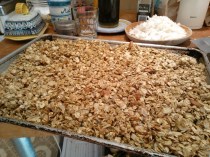
Transfer the whole mix to a baking sheet(s).  Don’ pile it too high and don’t be afraid to divide it between several pans if need be.  It will toast up more evenly and quicker when done in thinner layers.

WP_000491

Bake in a pre-heated 350F oven.  Use a timer and set if for 10 minutes.  When the timer goes off stir the mixture around using a spatula.  Put back in the oven and bake for another 6 minutes then check again and stir from the sides inward.  You’ll see that the granola mix will show you it is toasting from the edges of the pan inward so you’ll want to bring that towards the middle of the pan and mix in well.  Repeat this step again.  Just make sure that it is not getting too dark, too quickly.  Each oven can be different and it’s not uncommon for the calibration to be a bit off.

WP_000492

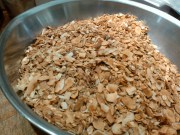
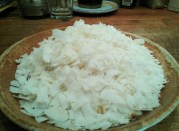
Next for the last 5 minutes of the baking process you’ll add the unsweetened, shredded coconut (and/ or dried fruit if you want).  We add this at the end otherwise it will over cook during the first phase of baking.  Remember that many recipes will have mix everything together then just toss it in the oven.  Taking the time to separate out the process into several steps will give you a great tasting, more nutritious granola.

WP_000496

Nutrition Facts Serving Size  (85g)  (About 3/4 cup or 3 oz by weight)

Amount Per Serving Calories 360    Calories from Fat 110    % Daily Value Total Fat 12 g 18 %  Saturated Fat 1.5 g 8 %  Trans Fat 0 g    Cholesterol 0 mg 0 %  Sodium 135 mg 6 %  Total Carbohydrate 54 g 18 %  Dietary Fiber 7 g 28 %  Sugars 16 g    Protein 9 g

Vitamin A   0 %  Vitamin C   0 %  Calcium   6 %  Iron   15 %

The sustainable athlete

What is sustainability? What should the sustainable athlete look like?  Probably not very different from anyone else who tries to do the right thing by shopping and eating seasonally and locally.  When it comes to the food choices we make its a good idea to start with some basic ethics.  Over time you may find yourself modifying them as you become more confident in where to shop and what to buy.

First lets take a look at what the term sustainability means.  Here are a couple of decent definitions with which I have no problem. The first is from a seemingly unlikely source the EPA  (  http://www.epa.gov/sustainability/basicinfo.htm )  On their webpage they write. “Sustainability is based on a simple principle: Everything that we need for our survival and well-being depends, either directly or indirectly, on our natural environment. Sustainability creates and maintains the conditions under which humans and nature can exist in productive harmony, that permit fulfilling the social, economic and other requirements of present and future generations.  Sustainability is important to making sure that we have and will continue to have, the water, materials, and resources to protect human health and our environment.”

Not bad.  While our friends over at Wikipedia offer a lengthy dissertation on the subject, one section specific to food systems,  ( http://en.wikipedia.org/wiki/Sustainability  ). It’s worth a read.  Check it out.

Admittedly the label of sustainability may seem to be overused, abused and co-opted by more than one company or corporation. The seemingly obvious conflicts of interest and lack of transparency work to further dilute the meaning and significance of the label.  Still, that is what we have and a better phrase hasn’t popped up yet.  We’ll leave it that eating sustainably can serve as a a road marker to a living and eating ethic. 

So rather than get into a full on scree about what we should be eating, why, where to purchase ( or not) I’m going to offer several guidelines for how I think a well seasoned athlete might purchase the foods they cook and eat.

WP_000428

Things to consider:

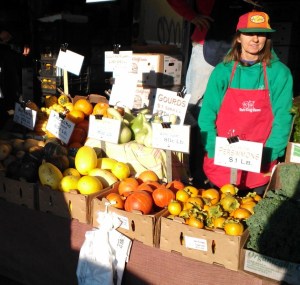
1.  Try shopping at a farmers’ market at least once a week.

2.  Buy the things that excite you and don’t be afraid to try a vegetable that you haven’t tried before.  WP_000438

3.  Don’t agonize over organic vs conventional at this point.  While I am a big advocate of organics supporting a local farmer is far more important.  Small(ish) scale farming more often keeps land in agriculture protecting green space.  It promotes a biodiversity of species. particularly pollinators (  see  http://www.pollinator.org/ ).

4.  Shop Seasonal and Local.  It’s about what is freshest and most nutritious.  It’s about looking at your carbon footprint.  It’s about supporting local economies and communities.

WP_0004405.  Try to stay away from foods that are in a bag, box or can as much as possible.
6.  Make as much of your food from scratch.  It’ll taste better and will allow you to better understand and connect with the foods you eat.

So the sustainable athlete, along with any specific dietary restrictions or needs, really can participate in supporting sustainable food systems.  It may take time and practice.  But, hey, that’s what we do everyday.

There you have it.

For further reading and opinions on sustainable eating and sustainable food systems see the Sustainable Ingredients page for useful links and suggestions.

Building Flavors

WP_000326 What makes a dish really tasty good?  Where in the process of prepareing a dish does the magic happen? How can I take a small handful of ingredients of a meal and gussey them up so that I’m smakin my lips and looking for seconds?  Well, here at The well seasoned athlete its time to reveal the secrets. And to be honest, its one part ingredient selection, one part technique and one part intuition.

Ingredients-  Typically I begin preparing lunch, dinner or what have you with some ingredient starting point.  It might be a vegetable, might be a super da kine slab of fish or a great looking cut of grass-fed beef from here in NorCal.  Curiously most of my fellow chefs agree that the starting point when composing menus is a particular ingredient which screams “use me, first!”  Its wicked fresh, speaks of incredible integrity or excits in some way.  Other parts of the menu or dish fall into place after that.  The fridge yields a bag of dino kale, some locally grown almonds.  The pantry holds a spice or two which I’ve been dying to try out.  On this day I happened to have two previously prepared items that were just waiting for the right moment to show their stuff.  One thing to keep in mind is that its okay to enhance an ingredient or two.  Here I’ll show you how.

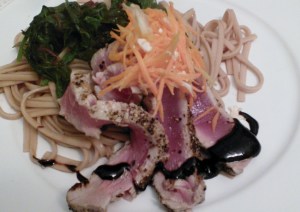
Technique and Intuition–  Let’s dig into a recent dish I prepared and see how it works. Seared Ahi Tuna, Udon with Mustard Greens, Soy Glaze, Gingerd Carrrots  (serves 2 people)

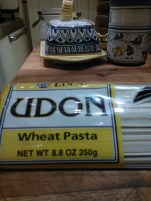
Here is the line up of ingredients.   Places where we will build flavor will be a. marinade for tuna; b. a light seasoning of the noodles prior to plating; c.tangy salad to accompany the dish and be a foil for the other flavors and textures; d. saucy type thing to hit the tuna with that keeps the taste buds wanting another bite. 

  •  12 oz Ahi Tuna (it can be in one or two pieces)
  • 6 oz Udon Noodles (dried in package ) (note: keep in mind that noodles of almost any kind will double in weight after cooking. So if you’re looking for more carbs then just measure up)
  • 3 oz Young Mustard Greens or Spinach (fresh only )
  • 4 oz Carrot, (peeled)
  • 3 oz Cauliflower or Green Cabbage
  • 1/2 oz pickled ginger (or 1/2 teaspoon fresh ginger grated fine mixed with 2 Tablespoon rice vinegar
  • 1/4 cup Soy (reduced sodium version is ok) mixed with 1 Tablespoon honey, 2 teaspoons rice vinegar, 2 teaspoons hot sauce (your call on brand)

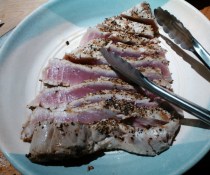
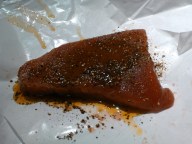
First place for magic: seasoning the fish.  Salt.  After that you can be creative.  Options include, cracked black pepper, chili flakes, zest of lemon or lime ( or combination of), minced garlic, sesame seeds, spice blends such as a North African or Vindaloo work well.  One key is not to get all carried away and throw everything at it.  If its a citrus flavor you are looking for just use the pepper, chile and garlic.  If its the Vindaloo or Indian spice flavors go with the garlic and pepper.  When you use a mix of fresh or dried herbs stick with garlic, pepper and a little citrus zest  .  WP_000323

It was decided that this dish was going include some Udon noodles, simply prepared by boiling. Easy enough, 9 minutes in boiling water, drain.

WP_000324

WP_000325

But here we can add a “behind the scenes” flavor by tossing with a two teaspoons of soy, two teaspoons of oil (olive or saflower), a dash of sesame oil and dash of hot sauce.  A light hand is needed here.  This is only to season the noodles, not make a sauce.  You’ll hardly taste it but the flavor is there and helps set up the palate for the rest of the dish.

Next, the young mustard greens or spinach.  Texture wise we have big flavored but sexy, soft tuna happening, silky noodles, a crunchy, tangy salad lurking ahead.  Traditionally this would call for a wilted or boiled vegetable like our greens.  Fresh flavor, fresh texture but soft and somewhat similar to the noodles.  The greens provide essential nutients, a vibrant color contrast but don’t fight the other elements of the dish.  All we do is give the greens a light steaming for 1 minute. Uncover and leave on the stove off the heat until ready to plate.

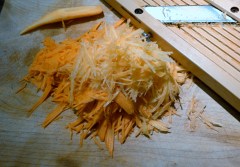
Now for the crunchy, tangy salad I mentioned above.  Shredded carrot mixed with chopped up raw cauliflower (or cabbage).  To get this right shred the carrots small.  You can use a box grater, the shredder blade of a food processor (Cuisinart) or a Japanese mandolin.

WP_000318

The cauliflower is just sliced thinly.  No need to make it pretty, its going to fall apart anyway and the thinner the better since it won’t be getting cooked.  (if you end up using cabbage give it the same treatment as the carrots)

WP_000319

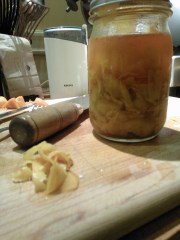
pickled ginger I put up last month

Mix the carrots and cauliflower in a bowl and add 2 Tablespoons of chopped pickled ginger and 2 Tablespooons of the pickled ginger vinegar. Allow the salad to sit for 10 minutes before serving  ( Now don’t worry.  If don’t have pickled ginger then simply grate 1/2 teaspoon of fresh ginger and toss with 2 Tablespoons of rice vinegar.  Let sit for a few minutes before mixing into the salad.)

Now its time to pull this together.This is where Intuition comes into play. Timing is important.  Which order do cook everything?

  1. Marinade Tuna.
  2. Prepare Carrot Salad.
  3. Reduce soy, honey, vinegar, hot sauce mix to a glaze. (takes only about 2 minutes in a small non-stick pan)
  4. Steam greens.
  5. Boil noodles.
  6. Cook the Tuna (this can happen while the noodles are in the pot cooking.
  7. Toss Noodles and Greens together with seasonings.
  8. Slice Tuna, plate up the noodles, garnish with sauce and salad.

Bingo!

WP_000328

Nutrition Facts Serving Size  (466g) Servings Per Container

Amount Per Serving Calories 720    Calories from Fat 160    % Daily Value Total Fat 18 g 28 %  Saturated Fat 3 g 15 %  Trans Fat 0 g    Cholesterol 65 mg 22 %  Sodium 1780 mg 74 %  Total Carbohydrate 80 g 27 %  Dietary Fiber 9 g 36 %  Sugars 12 g    Protein 57 g

Vitamin A   350 %  Vitamin C   90 %  Calcium   10 %  Iron   30 %

Weighing the Options

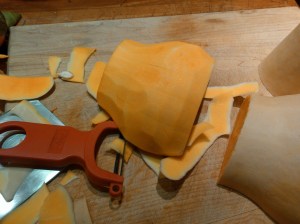
Peeled Squash

Butternut Squash being peeled

Last week I did the Butternut Squash Risotto.  At the time I started with something like a 3 lb squash that happily gave me way more squash than I needed for the risotto.  The choice at the time was to blanch all the squash and save half for something else.  It could have been tossed in the freezer for future reference or just placed on hold for few days until inspiration struck.  We decided on the latter.  So a few days later it was time to put the squash back into action.

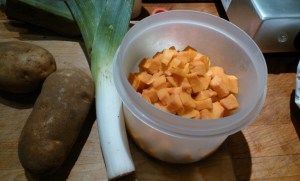
Prep for Squash Leek Soup
Potato-Leek-Prepped Squash

A trip to the farmers’ market happily produced three leeks, two russet potatoes and the urge to make soup.  Initially it was to be a potato leek duet but the squash got thrown into the mix.   No problem there.  Now we had a three-way.

First things first.  Leeks are notoriously dirty.  Kinda like your kid brother at age 5.  The strategy here is to trim off the green part just above where the white part fades to green.  Also cut off the root end about a 1/8 inch from the end.  Now wash the leeks well.  Dirt will get in the nooks and crannies around the green end.  Do the best you can then bring to the cutting  board and cut them into a 1/4 or 1/2 inch dice.  For the most part on a soup like this I don’t fuss too much with the sizing and all but habit usually takes over and we end up getting them in a uniform size.  Next I peel and dice the potatoes.  Again a 1/2 inch size is good.  The butternut squash is ready and waiting so its time to cook.

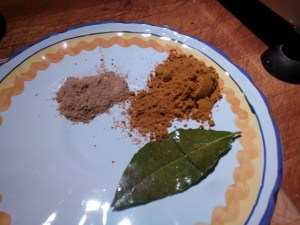
Heat 2 tablespoons extra virgin olive oil in a 2-3 quart pan.  When the oil is hot add the leeks, lower the heat and cook slowly for about 8 minutes, stirring occasionally.  Don’t let them color at all.  When they’re all good and melty add the potatoes and stir together. Now we add the magic.  Today its cardamom 1/2 teaspoon, curry powder 2 teaspoons, and bay leaf 1 each (I like the fresh ones but dried are ok too).

Spices for Soup

Cardamom (ground), Curry Powder, Bay Leaf

Add the spices and a tad of salt to the leek-potato mix. Stir again and let stew for a few minutes so the spices can absorb some of the vegetable love.

Leeks and Potatoes Simmering

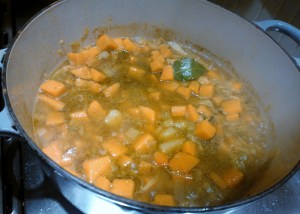
Now toss in the squash. Stir. Add 2 quarts of hot water.  Jack up the heat and bring to a simmer for 15 minutes.

Squash added to Soup

Squash, Potao and Leeks together with Water added

Now I had to take pause.  To puree or not to puree.  That is the question.  Lookin at this I thought that its chunky luv looks seemed too good to alter.  At this point we have reached a crossroads of cooking .  In other words we have can several ways to go here.  We can:   a. make this a hearty vegetable stew and add rice or little pasta like orzo.  b. Leave it chunky style which is really about the visuals and the mouthfeel experience of eating a soup with texture. Or, c. we can puree the soup and give it a more uptown treatment.  Pureeing applies a more lux approach to the dish.  Its smooth, feels unctuous in the mouth and looks and sounds more elegant.  You can even top it with a dollop of creme fraiche, sour cream or crumbled feta cheese.  The great thing is that there is no down side to this.  Whatever way it’ll be killer good.  All the same ingredients, same flavors but what’s great is that now you have more than one tool in your kit to build super food.

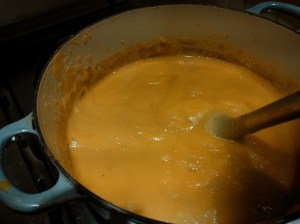
PureeIn the end a coin was tossed and puree it was.  Lucsious as it should be.  This recipe is vegan by the way.

Here are the nutrition numbers.  Remember that vegetables like Butternut Squash are nutrient dense and combined in a recipe like this delivers high value nutrition.

Nutrition Facts Serving Size  (399g) About  a 10 fluid oz Servings

Amount Per Serving Calories 150    Calories from Fat 45    % Daily Value Total Fat 5 g 8 %  Saturated Fat 0.5 g 3 %  Trans Fat 0 g    Cholesterol 0 mg 0 %  Sodium 450 mg 19 %  Total Carbohydrate 26 g 9 %  Dietary Fiber 4 g 16 %  Sugars 3 g    Protein 3 g

Vitamin A   170 %  Vitamin C   30 %  Calcium   6 %  Iron   10 %