Over the last couple of weeks I’ve been re-visiting the joys and flavors of chops from good, pasture raised pigs. Pretty much from coast to coast you can now find pork farmers who adhere to traditional methods of farming animals on pasture (as opposed to confinement farming ( See the Meatrix here ).
Here in northern California we have access to a handful of pork sources that don’t practice the confinement version of hog farming. Happily there are several that find their way into the retail market (as much of the good stuff ends up on restaurant menus these days). River Dog Farm who I mentioned in another post and Devils Gulch Ranch are but two examples.
About a year ago I was invited on a day tour of River Dog Farm along with a group of fellow chefs. As part of the walk-about the owner Tim Cambell explained how they came to be farming pigs. Being a sizeable organic fruit and vegetable farmer in Capay Valley, not far from Davis, California they composted those parts of the crops that don’t make the cut to be bagged, boxed and sold (or donated). Not a an uncommon practice actually. It may be hard to imagine but those compost piles get pretty damn huge. What with all the parts of tomato plants, eggplant fields, summer and hard squash stands left over as the seasons move along it immediately grows to a heaping big pile of plant matter. That along with the culls from each crop are often left to rot in the field or nearby untended. Its a lot of stuff, honestly. So for some time they simply composted all of it using the compost in some of their fields. Not a bad solution you think. Except that now they found themselves sending manpower and machinery to manage the compost piles. Soon the tail was wagging the dog. A great idea as far as sustainability in farming but the bottom line was the compose crop wasn’t paying for itself. Could there be a better way?
Hog farming as a value added crop. In early 2008 owners,Tim and Trini Cambell were talked into keeping a small population of pigs. As a trial they could feed them the culls of the crops, bruised tomatoes, carrots, funky squash, that sort of thing. Not wanting to replicate the resource investment of the compost business Tim and Trini were able to grow out a herd of hogs that are a cross of Old Tamworth, Duroc and feral wild hogs. This last breed helps greatly in the ability of the pigs to fend for themselves, both as foragers for their food but also in resisting wild predators like coyotes and taking care of their litters. A sequestered area down a long dirt road to a remote area behind several well-weathered barns became the hog pen. Moveable fencing allows the hogs to find wild forage of nuts, acorns grasses and roots. That plus the sorted culls aid in producing some healthy 300lb hogs. Now the hogs they farm are coveted by chefs and discerning home cooks across Northern California. Since their main passion and business are farming vegetables and fruits the hog side of things allows them to better manage an important aspect of their operation. And we get to enjoy some of the rewards too.
Rather than go into a lengthy treatise on the whys and what fores of pasture based animal husbandry I’ll just flat out say that it is the way to go. No amount of arguing the economics or culinary attributes will sway me from my opinion that factory farmed beef, pork or chicken is just plain wrong. Its bad for the air, land, water. The business model is horribly flawed. We read about some of the consequences weekly. And it makes for some not very tasty food. Sadly we have let ourselves go way too far down the road to the point where just three corporate entities control all of the animal protein production and sales in this country. Their industry is based on getting their product to market as quickly as possible at the expense of land, water, air and human resources. The promise of cheap, plentiful food is a hollow promise that all should question and resent.
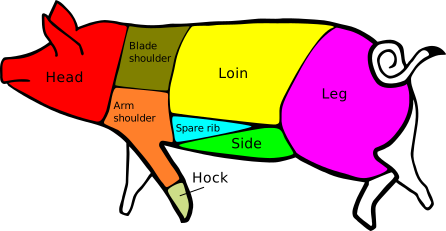
Done with that lets talk about chops. As a brief overview of a hog butcher cuts that we see in the display case we have the following. Keep in mind that this is a partial listing minus the nuance of beauty that an experienced eye, hand and knife can create.
- Shoulder (Boston butt, picnic ham) skin on or off.
- Loin ( bone on or off loin, baby back ribs, loin chops, pork chops, porterhouse pork chops, also the tenderloin is attached to the loin on the bone side towards its rear-ward end)
- Ham (along with ham this is where culatelo, prosciutto, ham hocks, pork osso bucco)
But this is really about chops. Probably most of us are more than familiar with your standard pork chop. Thin or thick it can make for some great eating. For this posting I’m going to focus on chops from the front and far end of the loin. Referring to the illustration at the top of the page first lets try chops from near the shoulder.
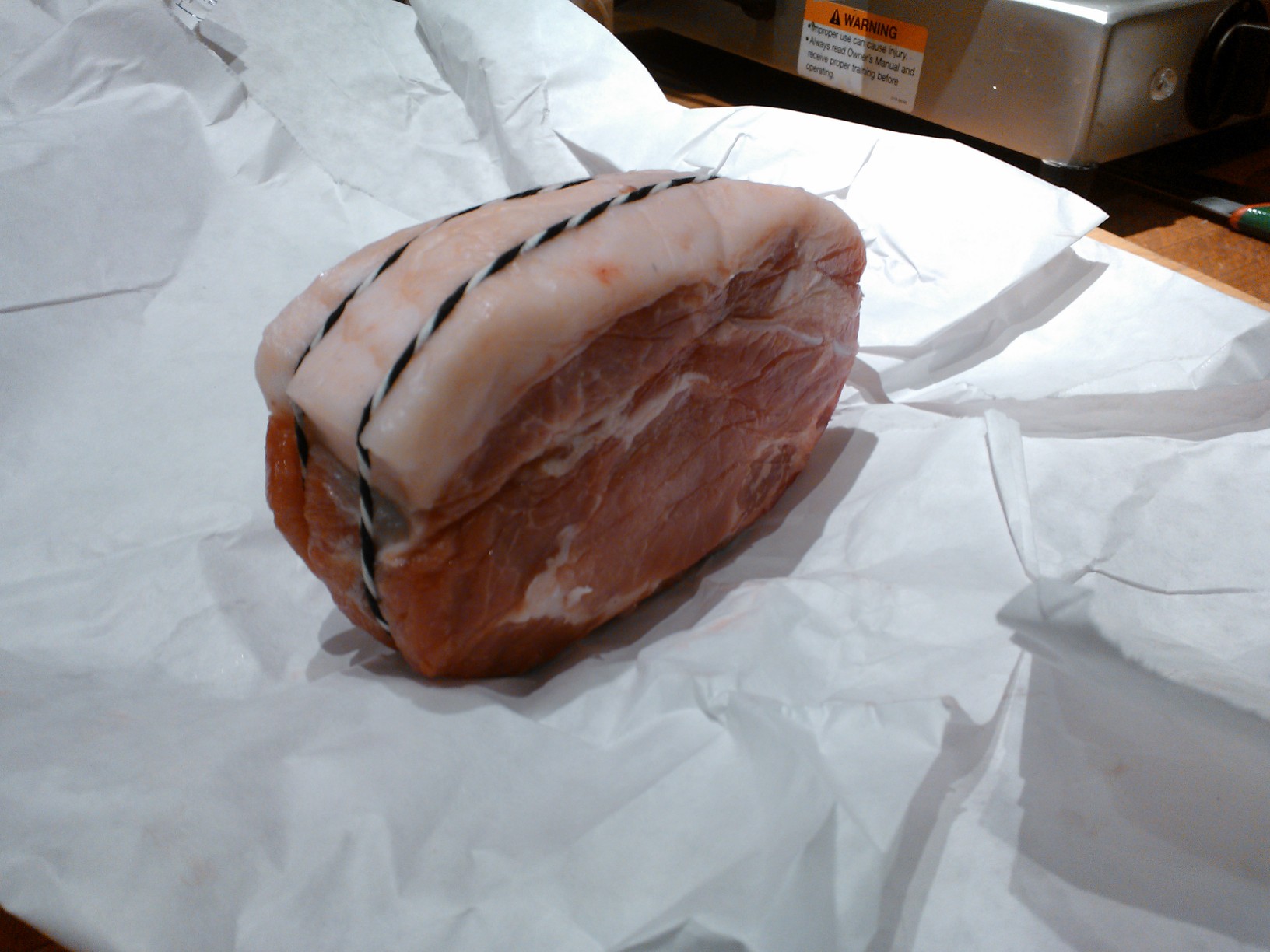
Pork Loin Shoulder Chop – click on pic for a larger view.
You can see in the picture there is a substantial amount of layering in the meat. These are different muscles overlapping the other each promising its own texture, marbling and flavor. Texture is as important here as is flavor. The closer to the shoulder we get the more “toothsome” the flesh becomes as the eye of the loin gets smaller with other shoulder muscles enveloping the loin. At the same time the shoulder meat is hella better marbled which means flavor with a capitol F. In cooking these kinda chops the word of the day is slow. And low. Thicker is better (this is for two) . Set the temperature gauge on the oven at 325 F. Give the chop(s) a good dose of salt and pepper, sear them off in a cast iron skillet over an aggressive flame then move it to the oven and walk away.


For a chop of 12-16 oz you’re lookin at near 15+ minutes or so. Use a good meat thermometer and pull it out when it hits 145F. Sit it on the cutting board and let the chop rest for 15 minutes. Resting your meat after cooking helps greatly with the final texture. Cut open right away and it will bleed away most of its juices (and flavor). Even more key is this will let the muscle fibers relax. Think suave-ricco on the palate.
Next up we travel down the loin to the aft end of the loin. Along the bottom end of the loin rests the tenderloin. Unlike the beef version which weighs in at 5 to 6 pounds the porcine version comes in at barely one pound and measures around 3 inches in diameter and about 12 inches long. The larger end begins just beyond the end of the loin where technically the sirloin would be but really becomes the leg or ham. Its sits there nestled snugly against the rib bones on the other side form the actual eye of the loin. Most often they’re removed, frozen and sold separately. A bit of a terrible thing to do to a worthy cut. Has done much to sour my desire to seek them out. One of those cuts that can be overrated and over cooked.
Salvation! If you cut a chop (or steak) from the aft end of the loin ( with the bone of course) and it has the tenderloin attached it gets to be christened a “porterhouse”. A happy union of pork loin, baby back rib bone and tenderloin wrapped with, OMG, pork fat. Done with care and attention this can be superb eating.

Pork Porterhouse- Loin eye on right, tenderloin on left. Luv all around.
For me I don’t get all cranked up fussin over fancy marinades and all. When I’m gearing to enjoy the flavor of the thing its salt and pepper, a smattering of herb, hint of garlic perchance, a smidge of zest too. A good sear to accentuate the flavor of the fat cover. And as we know- FAT is Flavor. A little can go a long way and in moderate doses can be a good thing. For many of us. Helps develop and focus flavor and can aid in telling the body that “hey, I’ve had some nourishment here and its enough for now”
This one was for two people and done in the fashion of Adam Perry Lang. from his book Scarred and Scruffed.

Cooked and Sliced! Loin on the right, tenderloin on the left.
.
 the well seasoned athlete
I read a lot of interesting posts here. Probably you spend a lot of time
writing, i know how to save you a lot of time, there
is an online tool that creates high quality,
SEO friendly posts in minutes, just search
in google – laranitas free content source