The sustainable athlete

What is sustainability? What should the sustainable athlete look like?  Probably not very different from anyone else who tries to do the right thing by shopping and eating seasonally and locally.  When it comes to the food choices we make its a good idea to start with some basic ethics.  Over time you may find yourself modifying them as you become more confident in where to shop and what to buy.

First lets take a look at what the term sustainability means.  Here are a couple of decent definitions with which I have no problem. The first is from a seemingly unlikely source the EPA  (  http://www.epa.gov/sustainability/basicinfo.htm )  On their webpage they write. “Sustainability is based on a simple principle: Everything that we need for our survival and well-being depends, either directly or indirectly, on our natural environment. Sustainability creates and maintains the conditions under which humans and nature can exist in productive harmony, that permit fulfilling the social, economic and other requirements of present and future generations.  Sustainability is important to making sure that we have and will continue to have, the water, materials, and resources to protect human health and our environment.”

Not bad.  While our friends over at Wikipedia offer a lengthy dissertation on the subject, one section specific to food systems,  ( http://en.wikipedia.org/wiki/Sustainability  ). It’s worth a read.  Check it out.

Admittedly the label of sustainability may seem to be overused, abused and co-opted by more than one company or corporation. The seemingly obvious conflicts of interest and lack of transparency work to further dilute the meaning and significance of the label.  Still, that is what we have and a better phrase hasn’t popped up yet.  We’ll leave it that eating sustainably can serve as a a road marker to a living and eating ethic. 

So rather than get into a full on scree about what we should be eating, why, where to purchase ( or not) I’m going to offer several guidelines for how I think a well seasoned athlete might purchase the foods they cook and eat.
WP_000428

Things to consider:

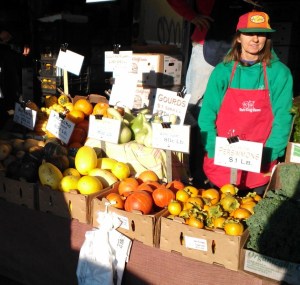
1.  Try shopping at a farmers’ market at least once a week.

2.  Buy the things that excite you and don’t be afraid to try a vegetable that you haven’t tried before.  WP_000438

3.  Don’t agonize over organic vs conventional at this point.  While I am a big advocate of organics supporting a local farmer is far more important.  Small(ish) scale farming more often keeps land in agriculture protecting green space.  It promotes a biodiversity of species. particularly pollinators (  see  http://www.pollinator.org/ ).

4.  Shop Seasonal and Local.  It’s about what is freshest and most nutritious.  It’s about looking at your carbon footprint.  It’s about supporting local economies and communities.

WP_0004405.  Try to stay away from foods that are in a bag, box or can as much as possible.

6.  Make as much of your food from scratch.  It’ll taste better and will allow you to better understand and connect with the foods you eat.

So the sustainable athlete, along with any specific dietary restrictions or needs, really can participate in supporting sustainable food systems.  It may take time and practice.  But, hey, that’s what we do everyday.

There you have it.

For further reading and opinions on sustainable eating and sustainable food systems see the Sustainable Ingredients page for useful links and suggestions.
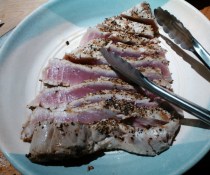
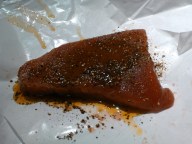
Building Flavors

WP_000326 What makes a dish really tasty good?  Where in the process of prepareing a dish does the magic happen? How can I take a small handful of ingredients of a meal and gussey them up so that I’m smakin my lips and looking for seconds?  Well, here at The well seasoned athlete its time to reveal the secrets. And to be honest, its one part ingredient selection, one part technique and one part intuition.

Ingredients-  Typically I begin preparing lunch, dinner or what have you with some ingredient starting point.  It might be a vegetable, might be a super da kine slab of fish or a great looking cut of grass-fed beef from here in NorCal.  Curiously most of my fellow chefs agree that the starting point when composing menus is a particular ingredient which screams “use me, first!”  Its wicked fresh, speaks of incredible integrity or excits in some way.  Other parts of the menu or dish fall into place after that.  The fridge yields a bag of dino kale, some locally grown almonds.  The pantry holds a spice or two which I’ve been dying to try out.  On this day I happened to have two previously prepared items that were just waiting for the right moment to show their stuff.  One thing to keep in mind is that its okay to enhance an ingredient or two.  Here I’ll show you how.

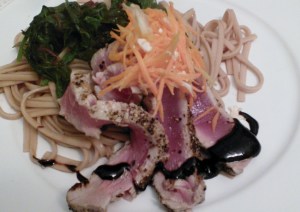
Technique and Intuition–  Let’s dig into a recent dish I prepared and see how it works. Seared Ahi Tuna, Udon with Mustard Greens, Soy Glaze, Gingerd Carrrots  (serves 2 people)

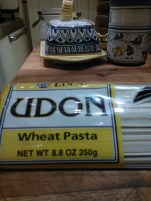
Here is the line up of ingredients.   Places where we will build flavor will be a. marinade for tuna; b. a light seasoning of the noodles prior to plating; c.tangy salad to accompany the dish and be a foil for the other flavors and textures; d. saucy type thing to hit the tuna with that keeps the taste buds wanting another bite. 

  •  12 oz Ahi Tuna (it can be in one or two pieces)
  • 6 oz Udon Noodles (dried in package ) (note: keep in mind that noodles of almost any kind will double in weight after cooking. So if you’re looking for more carbs then just measure up)
  • 3 oz Young Mustard Greens or Spinach (fresh only )
  • 4 oz Carrot, (peeled)
  • 3 oz Cauliflower or Green Cabbage
  • 1/2 oz pickled ginger (or 1/2 teaspoon fresh ginger grated fine mixed with 2 Tablespoon rice vinegar
  • 1/4 cup Soy (reduced sodium version is ok) mixed with 1 Tablespoon honey, 2 teaspoons rice vinegar, 2 teaspoons hot sauce (your call on brand)

First place for magic: seasoning the fish.  Salt.  After that you can be creative.  Options include, cracked black pepper, chili flakes, zest of lemon or lime ( or combination of), minced garlic, sesame seeds, spice blends such as a North African or Vindaloo work well.  One key is not to get all carried away and throw everything at it.  If its a citrus flavor you are looking for just use the pepper, chile and garlic.  If its the Vindaloo or Indian spice flavors go with the garlic and pepper.  When you use a mix of fresh or dried herbs stick with garlic, pepper and a little citrus zest  .  WP_000323

It was decided that this dish was going include some Udon noodles, simply prepared by boiling. Easy enough, 9 minutes in boiling water, drain.

WP_000324

WP_000325

But here we can add a “behind the scenes” flavor by tossing with a two teaspoons of soy, two teaspoons of oil (olive or saflower), a dash of sesame oil and dash of hot sauce.  A light hand is needed here.  This is only to season the noodles, not make a sauce.  You’ll hardly taste it but the flavor is there and helps set up the palate for the rest of the dish.

Next, the young mustard greens or spinach.  Texture wise we have big flavored but sexy, soft tuna happening, silky noodles, a crunchy, tangy salad lurking ahead.  Traditionally this would call for a wilted or boiled vegetable like our greens.  Fresh flavor, fresh texture but soft and somewhat similar to the noodles.  The greens provide essential nutients, a vibrant color contrast but don’t fight the other elements of the dish.  All we do is give the greens a light steaming for 1 minute. Uncover and leave on the stove off the heat until ready to plate.

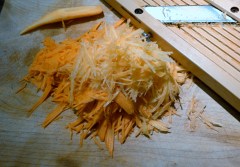
Now for the crunchy, tangy salad I mentioned above.  Shredded carrot mixed with chopped up raw cauliflower (or cabbage).  To get this right shred the carrots small.  You can use a box grater, the shredder blade of a food processor (Cuisinart) or a Japanese mandolin.

WP_000318

The cauliflower is just sliced thinly.  No need to make it pretty, its going to fall apart anyway and the thinner the better since it won’t be getting cooked.  (if you end up using cabbage give it the same treatment as the carrots)

WP_000319

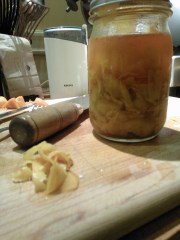
pickled ginger I put up last month

Mix the carrots and cauliflower in a bowl and add 2 Tablespoons of chopped pickled ginger and 2 Tablespooons of the pickled ginger vinegar. Allow the salad to sit for 10 minutes before serving  ( Now don’t worry.  If don’t have pickled ginger then simply grate 1/2 teaspoon of fresh ginger and toss with 2 Tablespoons of rice vinegar.  Let sit for a few minutes before mixing into the salad.)

Now its time to pull this together.This is where Intuition comes into play. Timing is important.  Which order do cook everything?

  1. Marinade Tuna.
  2. Prepare Carrot Salad.
  3. Reduce soy, honey, vinegar, hot sauce mix to a glaze. (takes only about 2 minutes in a small non-stick pan)
  4. Steam greens.
  5. Boil noodles.
  6. Cook the Tuna (this can happen while the noodles are in the pot cooking.
  7. Toss Noodles and Greens together with seasonings.
  8. Slice Tuna, plate up the noodles, garnish with sauce and salad.

Bingo!

WP_000328

Nutrition Facts Serving Size  (466g) Servings Per Container

Amount Per Serving Calories 720    Calories from Fat 160    % Daily Value Total Fat 18 g 28 %  Saturated Fat 3 g 15 %  Trans Fat 0 g    Cholesterol 65 mg 22 %  Sodium 1780 mg 74 %  Total Carbohydrate 80 g 27 %  Dietary Fiber 9 g 36 %  Sugars 12 g    Protein 57 g

Vitamin A   350 %  Vitamin C   90 %  Calcium   10 %  Iron   30 %

Weighing the Options

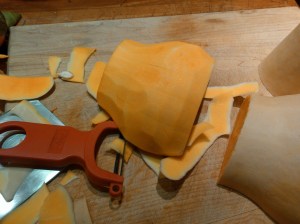
Peeled Squash

Butternut Squash being peeled

Last week I did the Butternut Squash Risotto.  At the time I started with something like a 3 lb squash that happily gave me way more squash than I needed for the risotto.  The choice at the time was to blanch all the squash and save half for something else.  It could have been tossed in the freezer for future reference or just placed on hold for few days until inspiration struck.  We decided on the latter.  So a few days later it was time to put the squash back into action.

Prep for Squash Leek Soup
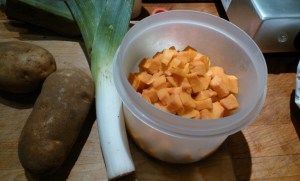
Potato-Leek-Prepped Squash

A trip to the farmers’ market happily produced three leeks, two russet potatoes and the urge to make soup.  Initially it was to be a potato leek duet but the squash got thrown into the mix.   No problem there.  Now we had a three-way.

First things first.  Leeks are notoriously dirty.  Kinda like your kid brother at age 5.  The strategy here is to trim off the green part just above where the white part fades to green.  Also cut off the root end about a 1/8 inch from the end.  Now wash the leeks well.  Dirt will get in the nooks and crannies around the green end.  Do the best you can then bring to the cutting  board and cut them into a 1/4 or 1/2 inch dice.  For the most part on a soup like this I don’t fuss too much with the sizing and all but habit usually takes over and we end up getting them in a uniform size.  Next I peel and dice the potatoes.  Again a 1/2 inch size is good.  The butternut squash is ready and waiting so its time to cook.

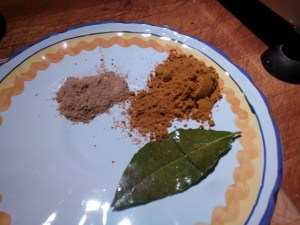
Heat 2 tablespoons extra virgin olive oil in a 2-3 quart pan.  When the oil is hot add the leeks, lower the heat and cook slowly for about 8 minutes, stirring occasionally.  Don’t let them color at all.  When they’re all good and melty add the potatoes and stir together. Now we add the magic.  Today its cardamom 1/2 teaspoon, curry powder 2 teaspoons, and bay leaf 1 each (I like the fresh ones but dried are ok too).

Spices for Soup

Cardamom (ground), Curry Powder, Bay Leaf

Add the spices and a tad of salt to the leek-potato mix. Stir again and let stew for a few minutes so the spices can absorb some of the vegetable love.

Leeks and Potatoes Simmering

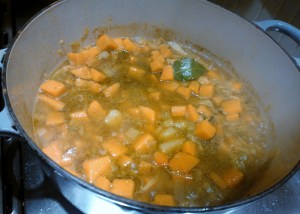
Now toss in the squash. Stir. Add 2 quarts of hot water.  Jack up the heat and bring to a simmer for 15 minutes.

Squash added to Soup

Squash, Potao and Leeks together with Water added

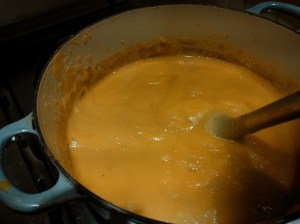
Now I had to take pause.  To puree or not to puree.  That is the question.  Lookin at this I thought that its chunky luv looks seemed too good to alter.  At this point we have reached a crossroads of cooking .  In other words we have can several ways to go here.  We can:   a. make this a hearty vegetable stew and add rice or little pasta like orzo.  b. Leave it chunky style which is really about the visuals and the mouthfeel experience of eating a soup with texture. Or, c. we can puree the soup and give it a more uptown treatment.  Pureeing applies a more lux approach to the dish.  Its smooth, feels unctuous in the mouth and looks and sounds more elegant.  You can even top it with a dollop of creme fraiche, sour cream or crumbled feta cheese.  The great thing is that there is no down side to this.  Whatever way it’ll be killer good.  All the same ingredients, same flavors but what’s great is that now you have more than one tool in your kit to build super food.

PureeIn the end a coin was tossed and puree it was.  Lucsious as it should be.  This recipe is vegan by the way.

Here are the nutrition numbers.  Remember that vegetables like Butternut Squash are nutrient dense and combined in a recipe like this delivers high value nutrition.

Nutrition Facts Serving Size  (399g) About  a 10 fluid oz Servings

Amount Per Serving Calories 150    Calories from Fat 45    % Daily Value Total Fat 5 g 8 %  Saturated Fat 0.5 g 3 %  Trans Fat 0 g    Cholesterol 0 mg 0 %  Sodium 450 mg 19 %  Total Carbohydrate 26 g 9 %  Dietary Fiber 4 g 16 %  Sugars 3 g    Protein 3 g

Vitamin A   170 %  Vitamin C   30 %  Calcium   6 %  Iron   10 %

Epic day of racing = Epic day of Cleaning!

Broke out the exclamation point for this one.  As well as the word epic.  The drive to the   CCCX  Race at Manzanita Park near Prunedale began just before 7am in 30+mph winds, sheets of rain and half light.   Kurt and I hung on for dear life car surfing at 30mph on 101.

Arriving around 9am we went thru reg, pinned numbers on, suited up and readied the rigs.  Did two laps of a mostly rideable and long course ( near 2 mi) , pulled off the course and hosed down the bike.  Since it was raining dogs, cats and something else a proper warm up was not a proper warm up.

As cross can be the course had changed dramatically from practice look around to race time.  Several sections became un-rideable, one 50 yard long section went along the first base line of a ball field and unsurprisingly became a 8 inch deep bog of brown the texture of pancake batter only containing hints of green.  Formerly grass.  Not a good race personally with a 5th place finish and feeling like it should have been more.  But that’s racing.  Rolled thru the finish and lined up at the hose for the post race wash down.

Next morning padded down to review the damage.  Every moving part had a scratchy sound coming from it.  Move the brake arms…. scratch, scratch.  Chain…more o’the same.  So began the tear down which only went deeper and deeper.  Bottom end had water inside the BB shell.  Drive side bearings sounded like they needed some attention. Brakes required an overhaul that had me digging around with Q-Tips.   Oh Man!

Rear wheel bearings now need a rebuild.  Well for anyone who races cross I’m preaching to the choir.  A teammate who is new to cross and has a new rig asked for advice for what to service and the following is what I wrote out.  Its December after all.  Racing cross every weekend (sometimes twice) exacts a toll.  Crack open a favorite, program the pod and settle in.  It’s what we do.

There are probably 5 major (depending) places to spend some attention.

1.  Chain  You can do one of two things here.  Take off the chain and slosh it around in a small container of Park Tool Solvent, let it drain then rinse in hot water with a small amount of soap then rinse once or twice in hot water.  Let dry for several hours then put back on bike and lubricate.  Second method requires buying the  Park Tool Cyclone Chain Scrubber chain washer gizmo which is actually pretty good but then you have to buy one.
2. Jockey Wheels and rear Derailleur.  Its possible that the small bearings on the jockey wheels need cleaned and lubed.  Not sure if you have SRAM or Shimano but they should be fairly easy to take off, apart, clean, lube and replace.  Easiest when chain is off.  Just be sure that if the two wheels are designated TOP and BOTTOM that you keep them in that order.;  I know that mine on the Campy set up are like that.
Take a moment to check the pivot points on the rear derailleur (and front) for ease of movement and no crunchy sounds.  I sometimes grab a can of that compressed air that they sell at Best Buy and some Radio Shacks.  It’s really good for blasting out grit in tight areas.  There like $12 or so for two cans.  You can apply a wee small amount of lube to the pivot points.
3. Brakes.  Clean the pads, clean out the grooves on the pads.  If really worn down replace.  The brake arms pivot on small bearings.  Best to take apart (remember the sequence of parts coming off) and clean.  Use a bike grease to apply a thin coating to all areas that move.
4.  Rear cassette  take it off and clean it up like new.  You’ll be surprised how quite the chain will be and shifting will be better.
5.  Crankset and Bottom Bracket-   Best to take the cranks off and clean behind the washers and seals.  Remove crankset and remove water from inside the bottom bracket shell.  (yes you’ll find dirty water there 😦
Clean chain rings well.  The ramps and grooves are there for better shifting.  If they crud up too much then you’ll notice it.  Grease all and put back together.
Depending on experience and tools this can be a couple of hours minimum.  A lot of work perhaps but needless to say that if you have been racing this season and even if you didn’t race in the worst of conditions its time to do an overhaul.  If you had your bike frolicking with the mud puppies over that time its imperative.
May be the difference between a podium or DNF not to mention the life expectancy
of you groupset.ut you’ll at times find things that are either worn, loose or really need attention.

Herb Brined Lamb Riblets, Yukon Gold Potato Salata, Sauerkraut Salad

Its pouring outside and its going to be an epic day of Cyclocross  racing tomorrow.  What with three days big rains and more on the way I needed something to distract me from the deluge out the back door.

One of the joys of cooking is finding neglected ingredients that are affordable.  Quite often these may the over looked root vegetable like celery root or turnips, herbs like Summer savory, or cuts of meat like pork shanks, beef flat-iron or lamb neck.   Among these I’m going to add lamb ribs.  If you enjoy good lamb like I do then grabbing several handfuls of these when they show up in the butcher case are a reason to celebrate.  If the ribs are in one small slab no problem.

Marin Sun Farms Lamb Spare Ribs ready for marinadeYou can simply run a knife down between each one or every other one if you chose.  Either way is fine, they’ll cook up the same.  Juicy and delicious.  But first a bit of marinade is in store.

Like any rib product they benefit from a bit of aggressive seasoning and slow cooking.  For these I  don’t go the sweet and sticky BBQ route but tend to give them an herby treatment with some chile and citrus.  Garlic never hurts as well.  Slow roasting  (see Techniques ) in the oven or grill is the ticket here.

First a we throw together a heady rub of oregano, thyme, fennel, parsley, garlic, black pepper, kosher sat ( for a good primer on salt types go here: foodnetwork kosher-vs-table-vs-sea-salt  ). Add in several teaspoons of fresh lemon zest ( my preference is meyer lemon) and a teaspoon of red chile flakes. Another tasty marinade idea would be mixing about  2 tablespoons of Za’atar with the garlic, oil and salt.  Next muss this up with 2 tablespoons of extra virgin olive oil and rub it in vigorously over all the surface of the riblets.  I like to let them sit for at least several hours at this point, even better over night.  A good trick is Marinade ready to happen.  Can you guess who they areto use a zip lock bag.  This is also a super trick for any type of marinated food.  Easier to store in fridge.

Here are the herbs lined up a ready to go.

Ribs soaking up the luv.

After some time together its time to grill.  Even in the rain the urge to grill can’t be held back.  Use a low heat for these and move the fire to one side with the riblets arranged on the grill on the other side away from the fire.  Put the cover on the grill and let them go for about 20 minutes, turning them over every 8 minutes or so.  Unlike pork ribs you don’t want these fall off the bone done.  They’re going to have a bit of grab to them.  Something like a medium well doneness but not charred. Remember low and slow.

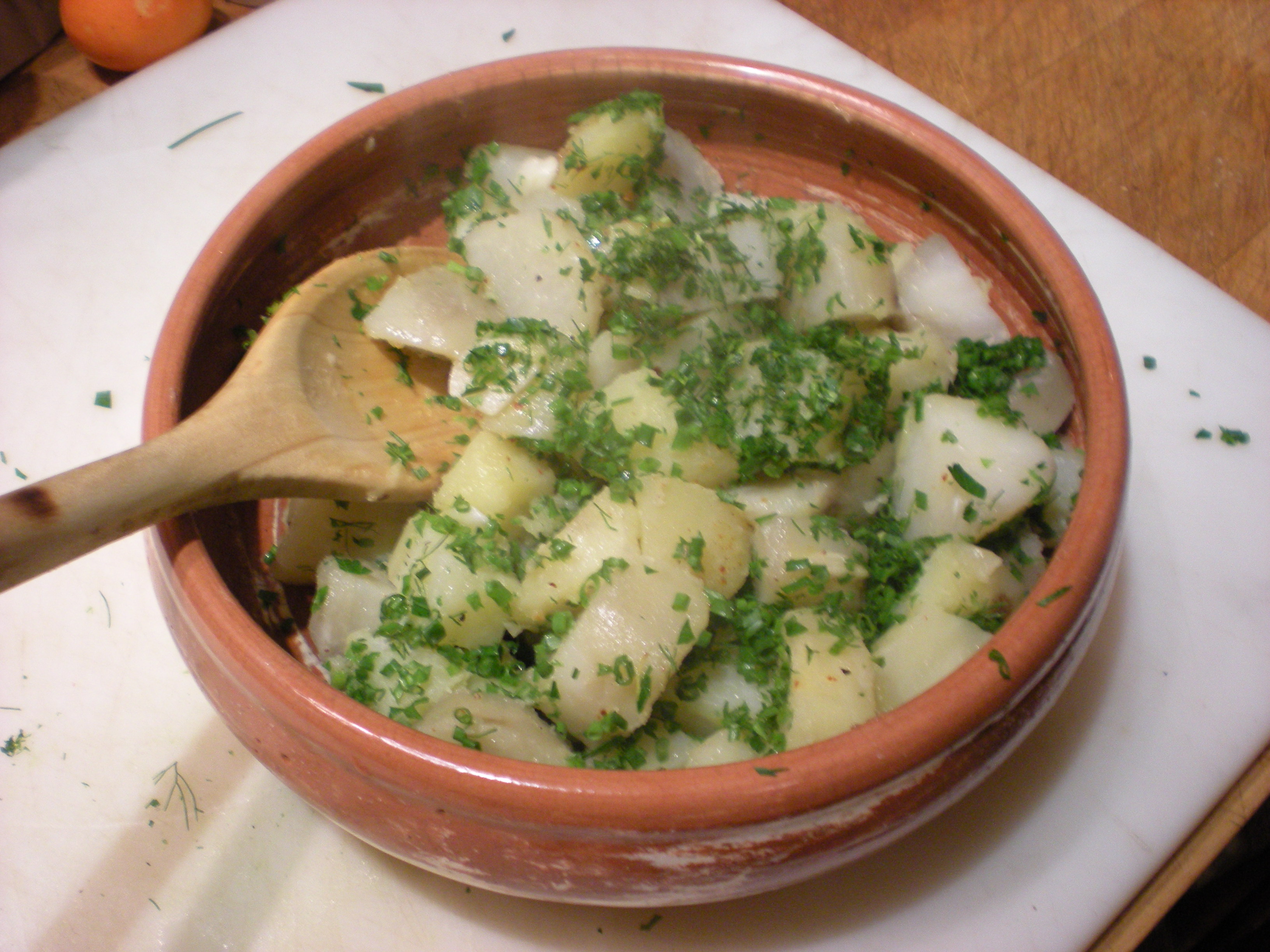
Ribs getting happy on the grill.While we let the riblets do their thing we turn our attention to the rest of the menu.  I chose a very simple warm potato salad.  This is a great fall back for when time is short.  Start with one pound of yukon gold potatoes left whole  (yukon gold history)  in a pot of water large enough to cover them with about 1/2 inch of water (start with cold, please).  Add a half teaspoon of salt and a bay leaf.  Set to boil and cook uncovered until the tip of a knife glides effortlessly through them.  This should take about 18 minutes from the time you turn on the flame.  When they’re tender done drain the water off.  Let them sit in the pot for a few minutes to cool.  When you can handle them cut each one into 1 inch pieces.  No need Ready for Fun!to be a stickler about shape here.  As you dice them up put them back in the pot.   When all are cut up add 1 1/2 tablespoons extra virgin olive oil, 3 tablespoons chopped parsley, a bit of kosher salt and 2 teaspoons of white wine vinegar ( oh heck if all you have is red wine vinegar then that’s okay).  A couple turns of the pepper grinder and its good to go.

Lastly, to round things out I decided to serve it all with a super salad of sauerkraut  (Sonoma Brinery.) and torn leaves of escarole or frisee.  You can use whatever your favorite might be.  And if you don’t have one then now’s the chance to do some research.  Cabbage is your friend.

Nutrition Facts Serving Size  (498g) Servings Per Container

Amount Per Serving Calories 600    Calories from Fat 290    % Daily Value Total Fat 33 g 51 %  Saturated Fat 9 g 45 %  Trans Fat 0 g    Cholesterol 120 mg 40 %  Sodium 1240 mg 52 %  Total Carbohydrate 37 g 12 %  Dietary Fiber 7 g 28 %  Sugars 4 g    Protein 40 g

Vitamin A   30 %  Vitamin C   80 %  Calcium   8 %  Iron   25 %

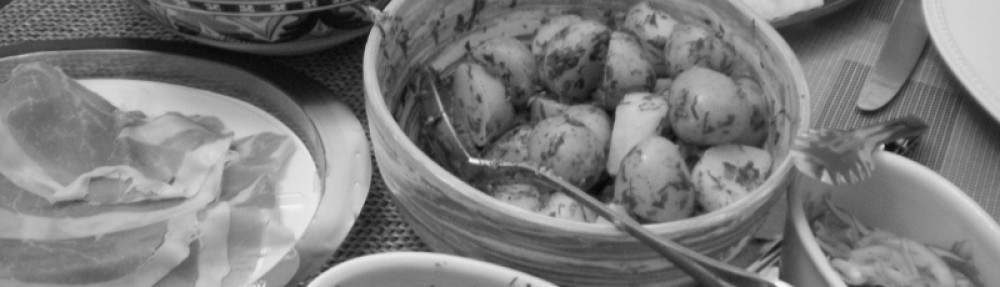
Grilled Spare Ribs, Alexander Valley Sauerkraut, LIttle Farm Potato Salad